


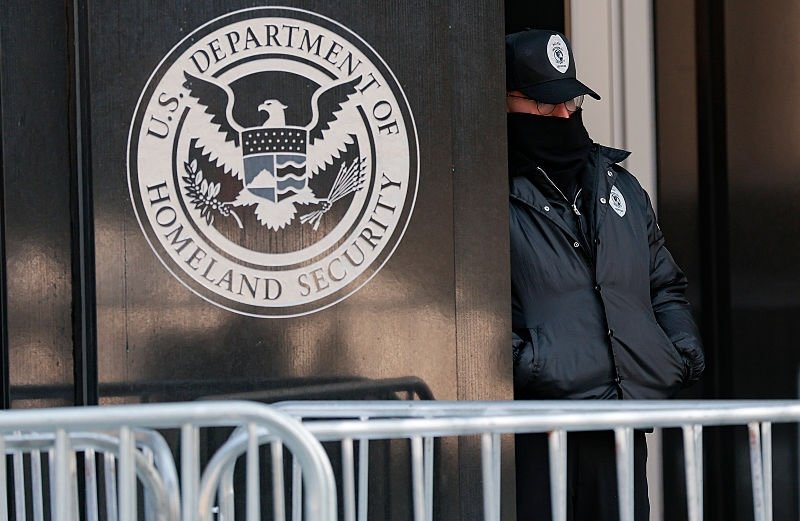
The Department of Homeland Security is quietly requiring tech companies to hand over user information about critics of the Trump administration, according to reports.
On several occasions in recent months, Homeland Security has relied on the use of subpoenas to seek identifying information about people with anonymous Instagram accounts who share posts about ICE immigration raids in their local neighborhoods. Those calls have also been used to request information about people who have criticized Trump officials or protested government policies.
Unlike subpoenas, which are approved by a judge after seeing enough evidence of a crime to authorize a search or seizure of someone’s belongings, administrative subpoenas are issued by federal agencies, allowing investigators to seek a wealth of information about people from technology and phone companies without a judge’s supervision.
While administrative subpoenas cannot be used to obtain the content of a person’s emails, web searches, or location data, they can request user-specific information, such as when a user logged in, from where, using which devices, and revealing email addresses and other identifiable information about who opened an online account. However, because administrative subpoenas are not backed by a judicial authority or court order, it is largely up to a company whether to hand over any data to the requesting government agency.
Administrative subpoenas are not new. The use of these signed requests by Trump officials to seek identifiable information about people critical of the president’s policies has raised alarm.
Bloomberg reported last week that Homeland Security sought the identity of an anonymous Instagram account that called @montocowatchwhich says its goal is to share resources to help protect immigrant rights and due process in Montgomery County, Pennsylvania. This comes amid an ongoing federal crackdown on immigration across the United States, which has drawn widespread protests and condemnation. Homeland Security lawyers sent an administrative subpoena to Meta demanding that it turn over the personal information of the person managing the account, citing a non-Homeland Security employee who claimed to have received a tip that ICE agents were in pursuit.
The American Civil Liberties Union, which represents the owner of the account, said there was no evidence of wrongdoing and that the police recording, the sharing of that recording and the anonymous act are legal and protected under the First Amendment. Internal security withdrew his summons without giving an explanation.
Techcrunch event
Boston, MA
|
June 23, 2026
The ACLU called the subpoena “part of a broader strategy to intimidate people who document immigration activity or criticize government actions.”
Bloomberg reported that the attempt to unmask the @montcowatch account was not an isolated incident, citing at least four other cases where Homeland Security officials used administrative subpoenas in efforts to track down the people who ran Instagram accounts that posted content critical of the government. Those calls were also pulled after the account owners sued to block the effort.
Tech companies have in recent years published transparency reports outlining how many government data requests they receive. But most don’t break out how many subpoenas and administrative subpoenas they receive over a period of time, even though the two types of requests are fundamentally different.
When asked by TechCrunch, Meta spokesman Francis Brennan did not say whether Meta provided Homeland Security with data pertaining to @montcowatch or whether the company was asked to provide information about the account in another way.
A new report from The Washington Post on Tuesday found that an administrative subpoena was also used to seek information from Google about an American retiree within hours of sending a critical email to Homeland Security’s lead attorney Joseph Dernbach. The retiree’s home was later visited by federal agents inquiring about the email.
The Post described the retiree as a critic of Trump during his first term, who attended a No Kings rally last yearhe regularly attended rallies and protests and wrote criticisms of lawmakers, all actions protected by the First Amendment.
Within five hours of emailing the Homeland Security attorney — who was named in an article on the case of an Afghan man the U.S. was trying to deport whose email address is listed on the Florida bar’s website — the retiree received an email from Google, according to the Washington Post. The email notified him that his account had been subpoenaed by the Department of Homeland Security.
The subpoena demanded to know the day, time and duration of all his online sessions, his IP address and physical address, as well as a list of every service he used, as well as any other usernames and identifiable information about his account, such as his credit card, driver’s license and social security numbers.
Two weeks later, Homeland Security agents were on his doorstep asking him questions about the email he sent to Dernbach, which the agents admitted did not break any laws.
Google spokeswoman Katelin Jabbari told TechCrunch that the company responds to excessive or inappropriate subpoenas, “as we did in this case,” referring to the subpoena cited in the Washington Post report.
When asked by TechCrunch, Assistant Homeland Security Secretary Tricia McLaughlin did not say why the US was seeking information about people critical of the Trump administration and accounts documenting ICE activity, nor did she say why the subpoenas were withdrawn.
“HSI has broad administrative subpoena authority under 8 USC § 1225(d) and 19 USC § 1509(a)(1) to issue subpoenas,” McLaughlin said, referring to Homeland Security Investigations, an investigative unit within ICE.
Not all companies are able to hand over data about their customers. For example, information that is end-to-end encrypted and can only be accessed by acquiring a person’s phone or devices. That said, many companies are still able to provide a large amount of information about their users, such as where they log in, how they log in, and from where, which can allow researchers to uncover anonymous accounts.
End-to-end encrypted messaging apps like Signal have long argued about how little data it collects about its users. The messaging app responds to occasional legal requirements by stating that it is unable to generate user data that you don’t have to start with.
Reliance on US tech giants is another reason why European countries and ordinary consumers are seeking to rely less on US tech giants, at a time when executives and senior executives at some of the biggest US tech companies are openly cozying up to the Trump administration.
