


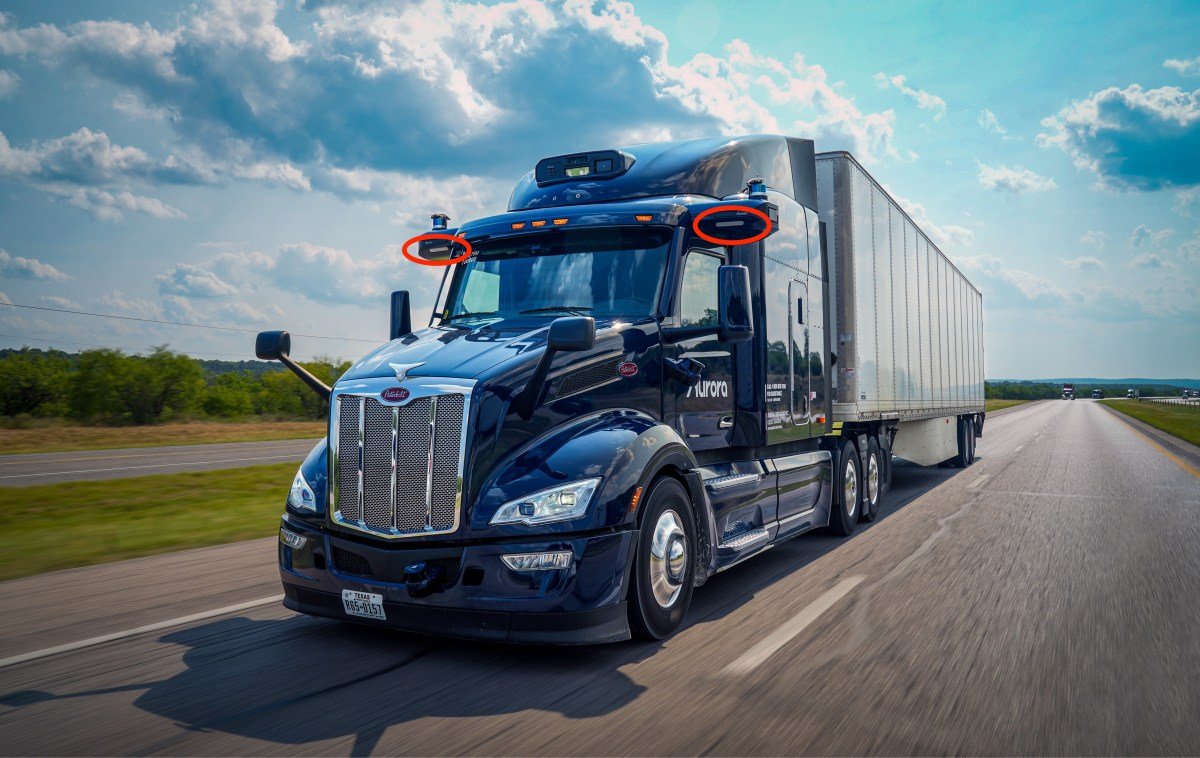
Aurora has added a 600-mile driverless route from Fort Worth to El Paso, the second self-driving technology company for its self-driving trucks.
The company announced the expansion Tuesday along with its third-quarter earnings report. Aurora also said it has completed more than 100,000 driverless miles on public roads with five self-driving trucks, a milestone for the company that launched its commercial service in May. The company’s next stated goal is to expand to Phoenix by the end of the year.
Aurora’s initial commercial service began with a route from Dallas to Houston with startup customers Hirschbach Motor Lines and Uber Freight.
The Fort Worth to El Paso route is long enough to make it exciting for carriers, according to Aurora, which cites staffing challenges and the difficulty of completing a 10-hour route in a single day. Customers on the El Paso route include Hirschbach Motor Lines as well as Russell Transport.
Aurora also shared details about the next-generation hardware, which is manufactured by Fabrinet and integrated with Volvo VNL autonomous trucks. Aurora plans to build 100 trucks with its next-generation hardware by 2026.
He says the material is more durable and performs better, yet is half the total cost. The company’s new generation lidar detects objects at a distance of 1,000 meters, which is twice the distance of the current generation. Aurora has also improved its sensor cleaning, which it says will work more reliably in harsh weather conditions.
“Integrating Aurora’s next-generation hardware with Volvo VNL Autonomous on the pilot line at our New River Valley facility marks an industry-first collaboration and highlights the significant progress we are making together,” said Nils Jaeger, president of Volvo Autonomous Solutions. “By building trucks purpose-built for autonomy, we’re moving beyond prototypes and creating scalable solutions that are ready to meet the demands of a modern supply chain.”
This next-generation hardware will precede a series of higher-volume hardware being developed jointly with Aumovio, formerly Continental, which is scheduled for production in 2027. The company plans to build “tens of thousands of self-driving trucks” when its manufacturing partnership with Aumovio begins in 2027.
