


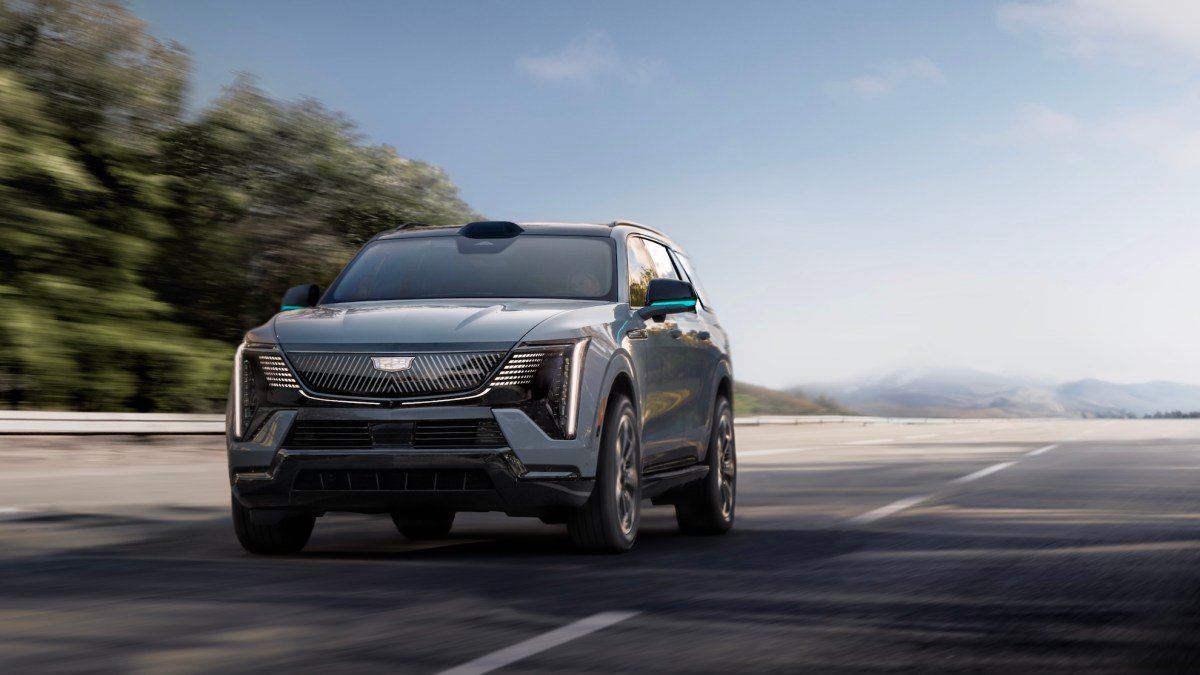
General Motors is overhauling the electrical and computing guts of its future vehicles in an effort to offer faster software, more capable self-driving features and a customized, conversational AI assistant.
The result of this revision will make its debut in 2027 in the Cadillac Escalade IQ.
The U.S. automaker, which unveiled its plans at an event Wednesday in New York, said a new electric architecture and central computing platform will be the foundation for all its future gas and electric vehicles starting in 2028. The next-generation supercomputer, Nvidia Drive AGX Thor, will power the computing unit — the the result of an expanded partnership between GM and Nvidia in March.
This under-the-hood renovation is a necessary step if the company wants to introduce more services and features, such as an AI chat assistant or a system that allows a car to safely navigate highways while the driver watches a movie — two products GM said it is working on and will bring to future vehicles. It would also allow GM to improve the performance of its vehicles, fix problems or add new features to its infotainment systems through software updates — all of which would make it more competitive with Tesla and the growing threat of Chinese automakers.
GM Chief Product Officer Sterling Anderson said he has focused on accelerating development of this new architecture since he joined the company in May because it “brings a lot of good things,” such as bandwidth and a “dramatic increase in compute.” It’s part of Anderson’s broader goal of getting technologically advanced products into the hands of consumers faster.
“Going forward, at the core of the business, my focus has really been on speed, product user experience and profitability,” Anderson told TechCrunch. “We’re looking across the business to find opportunities to dramatically reduce the development time for our vehicle platforms. Today, it’s in the four to five year range. I’d like to get it closer to two.”
Inside most modern vehicles, including GM’s Buick, Chevrolet, Cadillac and GMC brands, are dozens of small computers that handle everything from infotainment and safety systems to propulsion, steering and braking. The number of these computers, called electronic control units, or ECUs, has grown over the past decade as automakers have added more services and features. Tesla, which has taken an innovative, software-first approach, has been able to outperform established brands with more computing power and the ability to develop new features and improve performance through over-the-air software updates, similar to iPhones or Android-based smartphones.
Techcrunch event
San Francisco
|
27-29 October 2025
Legacy automakers have spent years, and billions of dollars, trying to catch up.
The industry widely agrees that part of the solution is to change the underlying hardware architecture to handle the growing computing appetites of entertainment features, safety systems and automated driving.
GM takes a similar, though not identical, approach to the zonal architectures used by Tesla and Rivian. GM said it will consolidate dozens of ECUs into a unified computer core that will coordinate every subsystem in the vehicle in real time. This core will be connected to three hubs – hubs that will convert the signals from hundreds of sensors in the vehicle into a unified digital language and then route the commands back to the correct hardware.
The result: The central computing platform will connect every system in the car, including propulsion, steering, braking, entertainment and safety, via a high-speed Ethernet backbone.
GM calls the plan a “complete rethink” of how its vehicles are designed, updated and improved over time. The end result, GM claims, will be vehicles with 10 times the ability to update software over-the-air, 1,000 times more bandwidth and up to 35 times more AI performance for autonomy and advanced functions.
GM has been on this software-centric path, redesigning the vehicle for several years.
In 2020, GM introduced an updated hardware architecture called the Vehicle Intelligence Platform (VIP) to enable greater data processing power and over-the-air software updates. The following year, GM unveiled an end-to-end cloud-based software platform called Ultifi, which executives promised would make vehicles more capable and give drivers access to in-car subscriptions and new apps and services via over-the-air updates. The Ultifi brand has since been dropped, but it exists on GM’s newer models and is the software that runs on top of the VIP architecture. GM continued its push for a more software-centric vehicle in 2022, when it consolidated dozens of computers used to run the infotainment system into a single computing platform.
GM says this latest move builds on all of that.
