


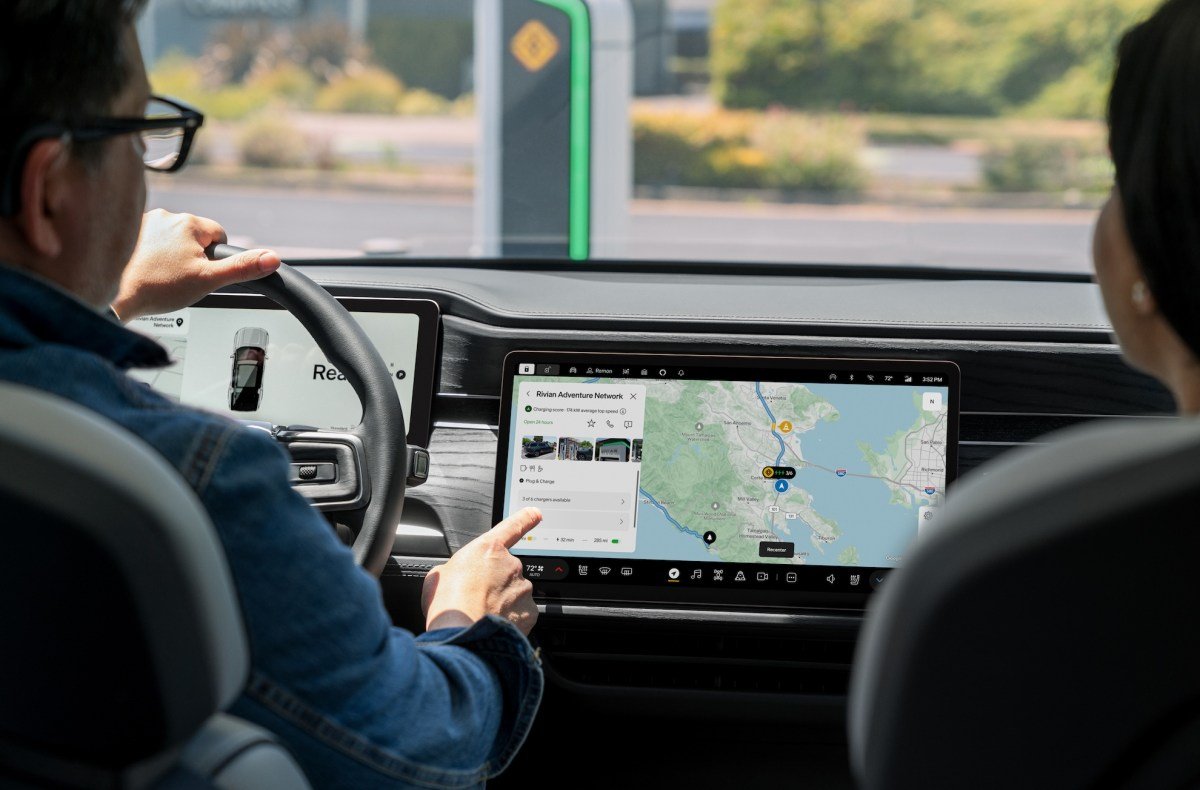
Rivian has spent nearly two years building its own AI assistant, an effort that remains separate from its multibillion-dollar technology joint venture with Volkswagen, according to TechCrunch.
Rivian hasn’t revealed when it will put the AI assistant in the hands of consumers. However, in an interview earlier this year, Rivian software chief Wassym Bensaid told TechCrunch that he was aiming for the end of the year. The company will likely share more during its upcoming release AI & Autonomy Daywhich will be broadcast live from 9 am. PT Dec. 11.
Rivian’s plans reflect the moment, as the pace of development by the foundational AI companies — the tech giants and startups like Anthropic, Google, Microsoft, Meta and OpenAI that build the underlying models and infrastructure — accelerates and industries scramble to keep up.
But as Bensaid noted to TechCrunch earlier this year, this isn’t an attempt to stay on trend. Nor is it just a chatbot thrown into the infotainment system. The company has put considerable thought, resources and time into the product, Bensaid said, noting that it is designed to integrate with all vehicle controls.
The company started with an underlying philosophy to build an overall architecture that is model and platform agnostic, according to Bensaid. Rivian’s AI assistant team, which is based in the company’s Palo Alto office, soon realized that effort and attention should also be directed toward developing the software layers that help coordinate various workflows as well as the control logic that resolves conflicts.
“And that’s the in-vehicle platform that we’ve built,” Bensaid said. “We use what the industry now likes to call an agent framework, but we thought about this architecture very early on so we could interface with different models.”
The in-house AI assistant program is consistent with Rivian’s push to become more vertically integrated. In 2024, Rivian overhauled its flagship R1T truck and R1S SUV, changing everything from the battery pack and suspension system to the electrical architecture, sensor stack and software user interface.
Techcrunch event
San Francisco
|
13-15 October 2026
The company has also devoted significant resources to developing and improving its own software stack, which includes everything related to real-time operating systems (RTOS) that manage the car, such as thermal dynamics, ADAS and safety systems, as well as another layer related to the infotainment system.
Bensaid did not provide details about the AI assistant, but said it includes a combination of models that handle specific tasks. The result is a hybrid software stack that combines edge AI, where tasks are handled on the device, and cloud AI, in which large, computationally intensive models are handled by remote servers.
This should mean a flexible, custom AI assistant that splits the workload between the edge and the cloud.
Rivian developed much of the AI software stack, including its own custom models and the “orchestration layer,” the conductor or conductor that makes sure the various AI models work together. Rivian leveraged other companies for specific AI functions.
The mission is to develop an AI assistant that increases customer trust and engagement, Bensaid said.
For now, the AI assistant resides at Rivian. The company’s joint venture with Volkswagen is focused on software, but not on an AI assistant or anything to do with automated driving.
The technology joint venture with Volkswagen, announced in 2024 and valued at up to $5.8 billion, focuses on the underlying electric architecture and the computing and entertainment belt. The joint venture was officially launched in November 2024 and is expected to supply the electrical architecture and software for the Volkswagen Group as early as 2027.
Autonomy and artificial intelligence are separate for now, but “doesn’t mean they might not be in the future,” Bensaid said.
