

Close Menu
TechTost
  • AI
  • Apps
  • Crypto
  • Fintech
  • Hardware
  • Media & Entertainment
  • Security
  • Startups
  • Transportation
  • Venture
  • Recommended Essentials
What's Hot

SaySo is a new short-form video app that aims to restore users’ trust in news

Uber will now collect your returns from your doorstep

Physical Intelligence, a hot robotics startup, says its new robot brain can understand tasks it was never taught

Facebook X (Twitter) Instagram
  • About Us
  • Contact Us
  • Privacy Policy
  • Terms and Conditions
  • Disclaimer
Facebook X (Twitter) Instagram
TechTost
Subscribe Now
  • AI

    Physical Intelligence, a hot robotics startup, says its new robot brain can understand tasks it was never taught

    17 April 2026

    Luma launches AI production studio with faith-focused Wonder Project

    17 April 2026

    Runway’s CEO Says AI Could Help Hollywood Make 50 Movies Instead of One $100 Million Blockbuster

    16 April 2026

    OpenAI updates its Agents SDK to help enterprises build safer, more capable agents

    16 April 2026

    Reid Hoffman weighs in on the ‘tokenmaxxing’ debate.

    15 April 2026
  • Apps

    Google’s AI feature can now help you find in-stock products nearby

    17 April 2026

    Google now lets you explore the web side-by-side with AI

    17 April 2026

    Canva’s AI assistant can now call on various tools to make designs for you

    16 April 2026

    AI learning app Gizmo soars with 13 million users and $22 million in investment

    16 April 2026

    Adobe’s new Firefly AI assistant can use Creative Cloud apps to complete tasks

    15 April 2026
  • Crypto

    British cryptographer Adam Back denies NYT report that he is Bitcoin creator Satoshi Nakamoto

    9 April 2026

    Hackers stole over $2.7 billion in crypto in 2025, data shows

    23 December 2025

    New report examines how David Sachs may benefit from Trump administration role

    1 December 2025

    Why Benchmark Made a Rare Crypto Bet on Trading App Fomo, with $17M Series A

    6 November 2025

    Solana co-founder Anatoly Yakovenko is a big fan of agentic coding

    30 October 2025
  • Fintech

    Airwallex is set to take on Stripe and the rest of the payments industry — in the physical world

    16 April 2026

    Cash app launches ‘pay later’ feature for P2P transfers

    3 April 2026

    Doss raises $55 million for AI inventory management that connects to ERP

    24 March 2026

    Despite stiff competition, Kalshi, Polymarket CEOs back $35m VC fund projections

    23 March 2026

    Amid legal turmoil, Kalshi is temporarily banned in Nevada

    20 March 2026
  • Hardware

    Amazon Unveils Slimmer Fire TV Stick HD, Opens Ember Artline TVs for Pre-Order

    16 April 2026

    Motorola is suing social platforms and creators over posts raising concerns about speech in India

    16 April 2026

    AI data center startup Fluidstack is in talks for a $1 billion round at an $18 billion valuation months after raising $7.5 billion, report says

    15 April 2026

    Amazon is ending support for older Kindle devices

    9 April 2026

    Intel signs Elon Musk’s Terafab chip project

    8 April 2026
  • Media & Entertainment

    Netflix co-founder and chairman Reed Hastings is stepping down from the board

    17 April 2026

    All we like is soulfulness

    16 April 2026

    Wait, could they still break up Live Nation?

    16 April 2026

    HBO Max is coming to India through an exclusive JioHotstar deal

    15 April 2026

    YouTube Live Streams will now withhold ads during peak engagement to protect the atmosphere

    14 April 2026
  • Security

    Fashion retailer Express leaked customers’ personal data and order details online

    17 April 2026

    Two Americans convicted of helping North Korea steal $5 million in fake IT worker scheme

    16 April 2026

    Sweden blames Russian hackers for attempted ‘catastrophic’ cyberattack on thermal plant

    15 April 2026

    Adobe fixes PDF zero-day security flaw that hackers have been exploiting for months

    15 April 2026

    Someone planted backdoors in dozens of WordPress plugins used on thousands of websites

    14 April 2026
  • Startups

    SaySo is a new short-form video app that aims to restore users’ trust in news

    17 April 2026

    From the Startup Battlefield to the International Space Station: geCKo Materials Made a Sticky Product

    17 April 2026

    This energy startup’s bet on 100-year-old grid technology is paying off

    16 April 2026

    Hightouch reaches $100M ARR powered by AI-powered marketing tools

    16 April 2026

    StrictlyVC San Francisco is less than a month away

    15 April 2026
  • Transportation

    Uber will now collect your returns from your doorstep

    17 April 2026

    Lucid Motors Appoints New CEO, Gets More Money From Uber, Saudis

    17 April 2026

    Monarch Tractor collapse ends with takeover by Caterpillar

    16 April 2026

    Ford EV and chief technology officer are leaving the auto industry

    16 April 2026

    Chipmakers AMD, Arm and Qualcomm are investing in this buzzing self-driving technology startup

    15 April 2026
  • Venture

    Anthropic rejects VC funding that values ​​it at $800B+, for now

    16 April 2026

    Financial risk management platform Pillar raises $20 million in rounds led by a16z

    15 April 2026

    Vercel CEO Guillermo Rauch signals IPO readiness as AI agents drive revenue

    14 April 2026

    Nvidia-backed SiFive hits $3.65 billion valuation for open AI chips

    11 April 2026

    How to make the Startup Battlefield Top 20 — and what each company gets regardless

    10 April 2026
  • Recommended Essentials
TechTost
You are at:Home»AI»Physical Intelligence, a hot robotics startup, says its new robot brain can understand tasks it was never taught
AI

Physical Intelligence, a hot robotics startup, says its new robot brain can understand tasks it was never taught

techtost.comBy techtost.com17 April 202606 Mins Read
Share Facebook Twitter Pinterest LinkedIn Tumblr Email
Physical Intelligence, A Hot Robotics Startup, Says Its New Robot
Share
Facebook Twitter LinkedIn Pinterest Email

Natural Intelligencethe two-year-old San Francisco-based robotics startup that has quietly become one of the Bay Area’s most closely watched AI companies has published new research Thursday, showing that its latest model can direct robots to perform tasks they’ve never been explicitly trained to do — a skill the company’s own researchers say caught them by surprise.

The new model, called π0.7, represents what the company describes as an early but essential step toward the coveted goal of a general-purpose robot brain: a brain that can be pointed at an unknown task, trained in plain language, and accomplished. If the findings hold up to scrutiny, they suggest that robotic AI may be approaching a tipping point similar to what the field saw with large language models—where capabilities begin to combine in ways that go beyond what the underlying data seem to predict.

But first: The key claim in the paper is the generalizability of synthesis—the ability to combine skills learned in different contexts to solve problems the model has never encountered. Until now, the standard approach to training robots has essentially been rote memorization — collect data for a specific task, train a specialized model on that data, then repeat for each new task. π0.7, says Natural Intelligence, breaks this pattern.

“Once you get past that threshold where you go from doing exactly the things you’re collecting the data for to mixing things up in new ways,” says Sergey Levine, co-founder of Natural Intelligence and a professor at UC Berkeley who focuses on artificial intelligence for robotics, “the capabilities grow much more than linearly with the amount of data. domains, such as language and vision’.

The paper’s most impressive demonstration involves an air fryer that the model has virtually never seen in training. When the research team investigated, they found only two relevant episodes in the entire training dataset: one where a different robot simply pushed the fryer to close, and one from an open-source dataset where another robot placed a plastic bottle inside one on someone’s instructions. The model had somehow synthesized these fragments, as well as broader web-based pre-training data, into a working understanding of how the device worked.

“It’s very difficult to pinpoint where knowledge comes from or where it will succeed or fail,” says Lucy Shi, a Natural Intelligence researcher and Ph.D. student. However, with zero training, the model made a credible attempt to use the device to cook a sweet potato. With step-by-step verbal instructions—essentially, a human walking the robot through the task the way you might explain something to a new employee—it was completed successfully.

This guidance capability is important because it suggests that robots could be deployed in new environments and improved in real time without additional data collection or retraining of models.

So what does this all mean? The researchers are not shy about the model’s limitations and are careful not to get ahead of themselves. In at least one instance, they point the finger right at their own team.

“Sometimes the failure mode is not in the robot or the model,” says Shi. “It’s up to us. We’re not good at direct engineering.” He describes an early air fryer experiment that had a 5% success rate. After spending about half an hour refining the way the work was explained in the model, it went up to 95%, he says.

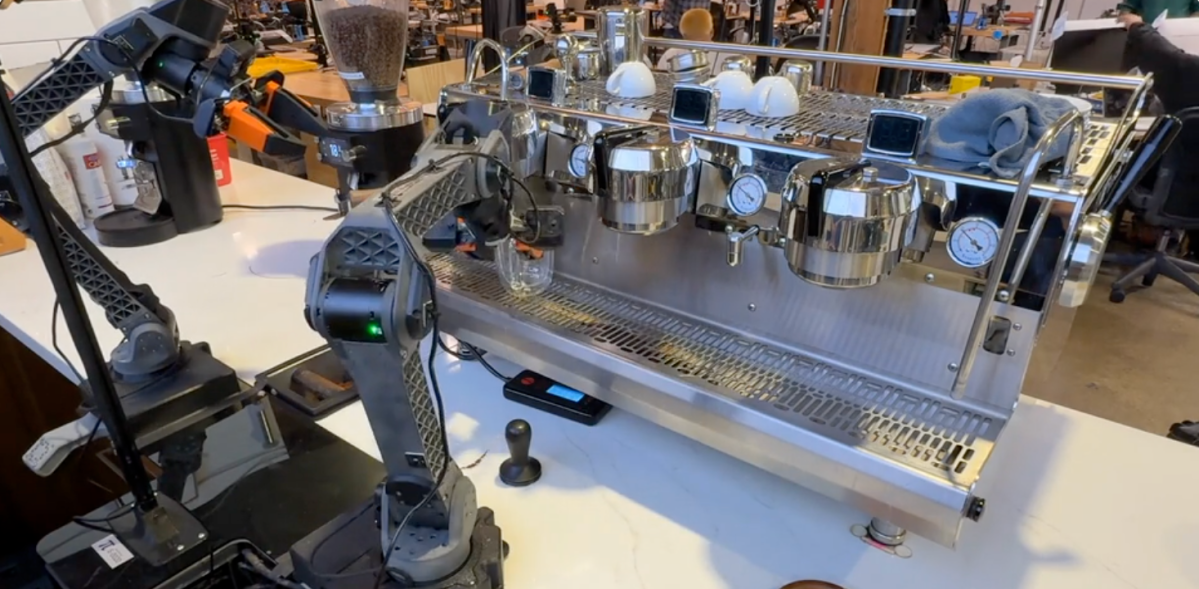
Image Credits:Natural Intelligence

Also, the model is not yet capable of autonomously performing complex multi-step tasks from a single high-level command. “You can’t tell it, ‘Hey, go make me some toast,'” says Levine. “But if you approach it—’for the toaster, open this part, press this button, do this’—then it actually tends to work really well.”

The team also acknowledged that there are no real standardized benchmarks for robotics, making it difficult to externally validate their claims. Instead, the company measured π0.7 against its own previous specialized models—custom-built systems trained on individual tasks—and found that the general model matched their performance on a range of complex tasks, such as making coffee, folding clothes, and assembling boxes.

What may be most remarkable about the research—if you consider the researchers—is not any demonstration but the extent to which the results surprised them, people whose job it is to know exactly what’s in the training data and therefore what the model should and shouldn’t do.

“My experience has always been that when I know deeply what’s in the data, I can just guess what the model will be able to do,” says Ashwin Balakrishna, a researcher at Physical Intelligence. “I’m rarely surprised. But the last few months was the first time I’ve been really surprised. I just bought a set of gears randomly and asked the robot, ‘Hey, can you turn this tool?’ And it just worked.”

Levine recalled the moment researchers first encountered GPT-2 by creating a story about unicorns in the Andes. “Where the hell did he learn about unicorns in Peru?” he says. “That’s such a strange combination. And I think to see that in robotics is really special.”

Of course, critics will point to an awkward asymmetry here: language models have had the entire Internet to learn. Bots don’t, and no amount of smart prompting fully closes that gap. But when asked where he expects skepticism, Levine points elsewhere.

“The criticism that can always be leveled at any demonstration of robotic generalization is that the tasks are kind of boring,” he says. “The robot doesn’t back up.” He pushes back against this framework, arguing that the distinction between an impressive robot demonstration and a robotic system that actually generalizes is precisely the point. Generalization, he suggests, will always seem less dramatic than a carefully choreographed stunt—but it’s far more useful.

The paper itself uses cautious hedging language, describing π0.7 as “early signs” of generalization and “initial demonstrations” of new capabilities. These are research results, not a developed product.

When asked directly when a system based on these findings might be ready for real-world deployment, Levine declines to speculate. “I think there’s good reason to be optimistic, and it’s certainly moving faster than I expected a few years ago,” he says. “But it is very difficult for me to answer that question.”

Natural Intelligence has raised over $1 billion to date and was recently valued at $5.6 billion. A significant part of the investor excitement surrounding the company can be traced to Lachy Groom, a co-founder who spent years as one of Silicon Valley’s most notable angel investors—backing Figma, Notion, and Ramp, among others—before deciding that Physical Intelligence was the company he was looking for. That pedigree helped the startup attract serious institutional money, even though it declined to offer investors a commercialization timeline.

The company is now said to be in talks for a new round that would nearly double that valuation to $11 billion. The group declined to comment.

Brain Exclusive hot intelligence Natural Intelligence Physical robot Robotics startup tasks taught understand
Share. Facebook Twitter Pinterest LinkedIn Tumblr Email
Previous ArticleGoogle’s AI feature can now help you find in-stock products nearby
Next Article Uber will now collect your returns from your doorstep
bhanuprakash.cg
techtost.com
  • Website

Related Posts

Fashion retailer Express leaked customers’ personal data and order details online

17 April 2026

From the Startup Battlefield to the International Space Station: geCKo Materials Made a Sticky Product

17 April 2026

Luma launches AI production studio with faith-focused Wonder Project

17 April 2026
Add A Comment

Leave A Reply Cancel Reply

Don't Miss

SaySo is a new short-form video app that aims to restore users’ trust in news

17 April 2026

Uber will now collect your returns from your doorstep

17 April 2026

Physical Intelligence, a hot robotics startup, says its new robot brain can understand tasks it was never taught

17 April 2026
Stay In Touch
  • Facebook
  • YouTube
  • TikTok
  • WhatsApp
  • Twitter
  • Instagram
Fintech

Airwallex is set to take on Stripe and the rest of the payments industry — in the physical world

16 April 2026

Cash app launches ‘pay later’ feature for P2P transfers

3 April 2026

Doss raises $55 million for AI inventory management that connects to ERP

24 March 2026
Startups

SaySo is a new short-form video app that aims to restore users’ trust in news

From the Startup Battlefield to the International Space Station: geCKo Materials Made a Sticky Product

This energy startup’s bet on 100-year-old grid technology is paying off

© 2026 TechTost. All Rights Reserved
  • About Us
  • Contact Us
  • Privacy Policy
  • Terms and Conditions
  • Disclaimer

Type above and press Enter to search. Press Esc to cancel.