


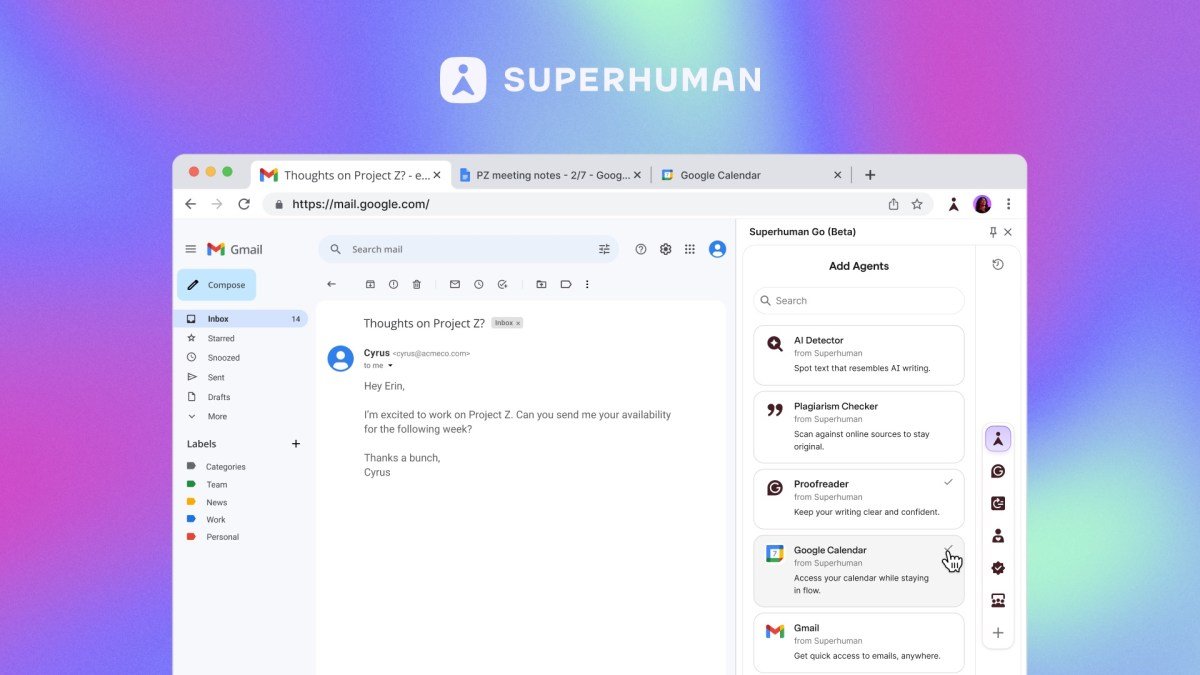
Typically, when one company acquires another, it will absorb the new company’s branding or incorporate it into its own identity. Grammarly is doing something different: After acquiring email client Superhuman in July, the company is rebranding as “Superhuman.”
Despite the rebrand, Grammarly, the product, will continue to be known as it is. But the company says it’s considering long-term changes to products like Coda, a productivity platform it acquired last year.
The company is also launching an AI assistant called Superhuman Go that is integrated into Grammarly’s existing extension. The assistant can provide writing suggestions, give feedback on emails, and you can even connect it to other apps like Jira, Gmail, Google Drive, and Google Calendar to arm it with more context. The assistant can use these connections to do tasks like log tickets or retrieve your availability when you schedule a meeting.
Superhuman said it plans to add functionality to let the assistant pull data from sources like CRM and internal systems to suggest changes to your emails.
Users can try out Superhuman Go by enabling a toggle in the Grammarly extension, which will allow them to connect it to different apps. Users can also try out different agents in the company’s agent store, which includes a plagiarism checker and a fixer, which was released in August.
All Grammarly users can try Superhuman Go right now, though the company also sells bundled products. The Pro subscription plan will cost $12 per month (billed annually) and will allow grammar and tone support in multiple languages. The business plan will cost $33 per month (billed annually) and will give users access to Superhuman Mail.
Superhuman said it also wants to add more AI-powered features to its Coda document suite and Superhuman email clients, such as retrieving details from external and internal sources to create additional details in documents and email drafts automatically.
Techcrunch event
San Francisco
|
13-15 October 2026
Grammarly has made a concerted effort in recent years to increase its viability as a productivity suite, as evidenced by its acquisitions of Coda and Superhuman. With this AI assistant, the company is positioning itself to better compete with Notion, ClickUp, and Google Workspace, which have released multiple AI-powered features in recent years.
