

Close Menu
TechTost
  • AI
  • Apps
  • Crypto
  • Fintech
  • Hardware
  • Media & Entertainment
  • Security
  • Startups
  • Transportation
  • Venture
  • Recommended Essentials
What's Hot

Eclipse Energy’s microbes can turn dormant oil wells into hydrogen factories

Inside Rivian’s big bet on self-driving with artificial intelligence

DoorDash driver faces felony charges after allegedly spraying customers’ food

Facebook X (Twitter) Instagram
  • About Us
  • Contact Us
  • Privacy Policy
  • Terms and Conditions
  • Disclaimer
Facebook X (Twitter) Instagram
TechTost
Subscribe Now
  • AI

    Trump’s AI executive order promises ‘a rulebook’ – startups may find legal loophole instead

    13 December 2025

    Ok, so what’s up with the LinkedIn algo?

    12 December 2025

    Google Released Its Deepest Research AI Agent To Date — The Same Day OpenAI Dropped GPT-5.2

    12 December 2025

    Disney hits Google with cease and desist alleging ‘massive’ copyright infringement

    11 December 2025

    Google’s answer to the AI ​​arms race — promote the guy behind its data center technology

    11 December 2025
  • Apps

    DoorDash driver faces felony charges after allegedly spraying customers’ food

    13 December 2025

    Google Translate now lets you listen to real-time translations on your headphones

    13 December 2025

    With iOS 26.2, Apple lets you bring back Liquid Glass again — this time on the lock screen

    12 December 2025

    World launches its ‘super app’, including payment encryption and encrypted chat features

    12 December 2025

    Epic Games’ Fortnite is back on the US Google Play Store after a court partially lifted the restrictions it won on iOS

    11 December 2025
  • Crypto

    New report examines how David Sachs may benefit from Trump administration role

    1 December 2025

    Why Benchmark Made a Rare Crypto Bet on Trading App Fomo, with $17M Series A

    6 November 2025

    Solana co-founder Anatoly Yakovenko is a big fan of agentic coding

    30 October 2025

    MoviePass opens Mogul fantasy league game to the public

    29 October 2025

    Only 5 days until Disrupt 2025 sets the startup world on fire

    22 October 2025
  • Fintech

    Coinbase starts onboarding users again in India, plans to do fiat on-ramp next year

    7 December 2025

    Walmart-backed PhonePe shuts down Pincode app in yet another step back in e-commerce

    5 December 2025

    Nexus stays out of AI, keeping half of its new $700M fund for India startup

    4 December 2025

    Fintech firm Marquis notifies dozens of US banks and credit unions of data breach after ransomware attack

    3 December 2025

    Revolut hits $75 billion valuation in new capital raise

    24 November 2025
  • Hardware

    Pebble founder unveils $75 AI smart ring to record short notes with the push of a button

    10 December 2025

    Amazon’s Ring launches controversial AI-powered facial recognition feature on video doorbells

    10 December 2025

    Google’s first AI glasses are expected next year

    9 December 2025

    eSIM adoption is on the rise thanks to travel and device compatibility

    6 December 2025

    AWS re:Invent was an all-in pitch for AI. Customers may not be ready.

    5 December 2025
  • Media & Entertainment

    Disney signs deal with OpenAI to allow Sora to create AI videos with its characters

    11 December 2025

    YouTube TV will launch genre-based subscription plans in 2026

    11 December 2025

    Founder of AI startup Tavus says users talk to AI Santa ‘for hours’ a day

    10 December 2025

    Spotify releases music videos in the US and Canada for Premium subscribers

    9 December 2025

    Amazon Music’s 2025 Delivered is now here to compete with Spotify Wrapped

    9 December 2025
  • Security

    The flaw in the photo booth manufacturer’s website exposes customers’ photos

    13 December 2025

    Home Depot exposed access to internal systems for a year, researcher says

    13 December 2025

    Security flaws in the Freedom Chat app exposed users’ phone numbers and PINs

    11 December 2025

    Petco takes down Vetco website after exposing customers’ personal information

    10 December 2025

    Petco’s security bug affected customers’ SSNs, driver’s licenses and more

    9 December 2025
  • Startups

    Eclipse Energy’s microbes can turn dormant oil wells into hydrogen factories

    13 December 2025

    Interest in Spoor’s AI bird tracking software is soaring

    13 December 2025

    Retro, a photo-sharing app for friends, lets you ‘time travel’ to your camera roll

    12 December 2025

    On Me Raises $6M to Shake Up the Gift Card Industry

    12 December 2025

    1X has struck a deal to send its ‘homemade’ humanoids to factories and warehouses

    11 December 2025
  • Transportation

    Inside Rivian’s big bet on self-driving with artificial intelligence

    13 December 2025

    Zevo wants to add robotaxis to its car-sharing fleet, starting with newcomer Tensor

    13 December 2025

    Driving aboard Rivian’s fight for autonomy

    12 December 2025

    Rivian goes big on autonomy, with custom silicon, lidar and a hint of robotaxis

    12 December 2025

    Rivian’s AI assistant is coming to its electrics in early 2026

    11 December 2025
  • Venture

    Runware raises $50 million in Series A to make it easier for developers to create images and videos

    12 December 2025

    Stanford’s star reporter understands Silicon Valley’s startup culture

    12 December 2025

    The market has “changed” and founders now have the power, VCs say

    11 December 2025

    Tiger Global plans cautious business future with new $2.2 billion fund

    8 December 2025

    Sources: AI-powered synthetic research startup Aaru raises Series A at $1B ‘headline’ valuation

    6 December 2025
  • Recommended Essentials
TechTost
You are at:Home»AI»NASA’s robotic, self-assembling structures could be the next phase of space construction
AI

NASA’s robotic, self-assembling structures could be the next phase of space construction

techtost.comBy techtost.com22 January 202406 Mins Read
Share Facebook Twitter Pinterest LinkedIn Tumblr Email
Nasa's Robotic, Self Assembling Structures Could Be The Next Phase Of
Share
Facebook Twitter LinkedIn Pinterest Email

Bad news if you want to move to the moon or Mars: housing is a little hard to come by. Luckily, NASA (as always) is thinking ahead and just showed off a self-assembling robotic structure that just might be a critical part of off-planet travel.

Published today in Science Robotics, the paper from NASA’s Ames Research Center describes the creation and testing of what they call “self-reprogrammable mechanical metamaterials,” which is a very precise way of describing a building that constructs itself. The inevitable acronym for this is “Automated Reconfigurable Mission Adaptive Digital Assembly Systems” or ARMADAS.

“We think this type of fabrication technology can serve many very general applications,” lead author Christine Gregg told TechCrunch. “In the near future, the strong autonomy and lightweight structures of our approach greatly benefit applications in harsh environments such as the lunar surface or space. This includes the construction of communication towers and shelters on the lunar surface, which will be needed before the astronauts arrive, as well as structures in orbit, such as arms and antennas.”

The basic idea of ​​the self-constructing structure lies in an intelligent synergy between the building material – cubic octahedral frameworks called voxels – and the two types of robots that assemble them.

One type of robot walks along the surface on two legs, seemingly inspired by the kinesin transport molecules of our own biology, carrying a voxel like a backpack. When this is fitted, a fixing robot that lives inside the frame itself like a worm slides in and tightens the reversible tie-down points. Neither needs a powerful detection system, and the way they work means high accuracy isn’t required either.

You can see a pair of walkers and a mounting worm in most of the images in this post. And here’s a transport walker delivering a voxel to a placement walker, with the clipper bot lurking underneath waiting to go and lock the frame into place.

Two robots exchange a building block while a third waits below to attach it to the grid. Image Credits: NASA

The shape of the pieces allows them to be attached at various angles while maintaining the good strength of the structure. You probably wouldn’t want to store rocks on top of a dome made of this stuff, but it would be great as a base to add insulation and waterproofing to create a dwelling.

“We believe this type of construction is particularly well-suited for long-duration and/or very large infrastructure, including habitats, instruments, or any other infrastructure in orbit or on the lunar surface (utility towers, vehicle landing facilities),” said co- author Kenneth Chung. “For us, structures and all robotic systems are resources that can be optimized in space and time. It seems like there will always be situations where the optimal thing is to just leave the structure in place (and maybe visit it to inspect it with a robot periodically), so that’s where we started.”

The pieces themselves could also be fabricated on site, Gregg noted:

“Voxels can be made from many different materials and manufacturing processes. Ultimately, for space applications, we would like to make voxels from materials found in situ on the moon or other planetary bodies.”

Of course, these videos of robots at work are highly sped up, but unlike working in a factory or on a sidewalk, speed isn’t necessarily of the essence when it comes to building things in space or on the surface of another planet.

“Our robots can run faster than this paper shows, but we didn’t think it was critical to the primary goals to make them do that. Essentially, the way to make this system work faster is to use more robots,” Cheung said. “The overall strategy for scalability (speed, size) is to be able to drive scale complexity in algorithms, for design and programming as well as for debugging and performing repairs.”

The lab-developed robots took 256 voxels and assembled them into a walkable shelter structure during a total of 4.2 working days. Here’s what the beginning of this looked like (again, nowhere in real time):
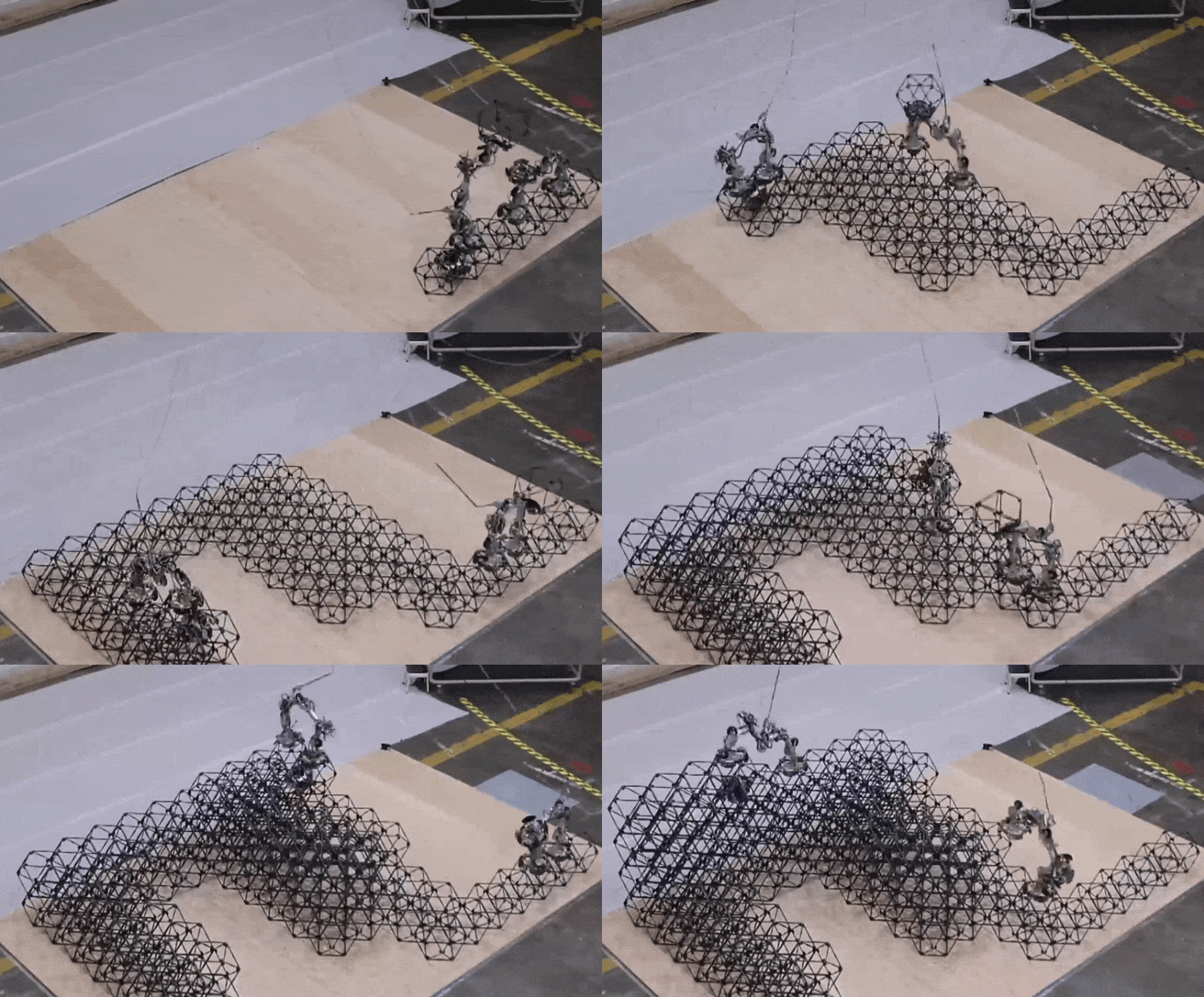
Image Credits: NASA

If we sent them to Mars or the moon a year before a crew, they could build a dozen such structures twice the size with time to spare. Or maybe they could stick the necessary lining on the outside afterwards and seal it – that’s probably beyond the scope of today’s published work, but an obvious next step.

Although the robots are tethered to this laboratory environment, they are designed with battery operation or field power in mind. The connector bot is already battery-powered, and researchers are looking at ways to keep the walkers charged between or even during operations.

“We envision robots being able to autonomously recharge at power stations or even transmit power wirelessly. As you mentioned, power could also be routed through the structure itself, which can be useful for powering the structure as well as powering the robots,” Greg said.
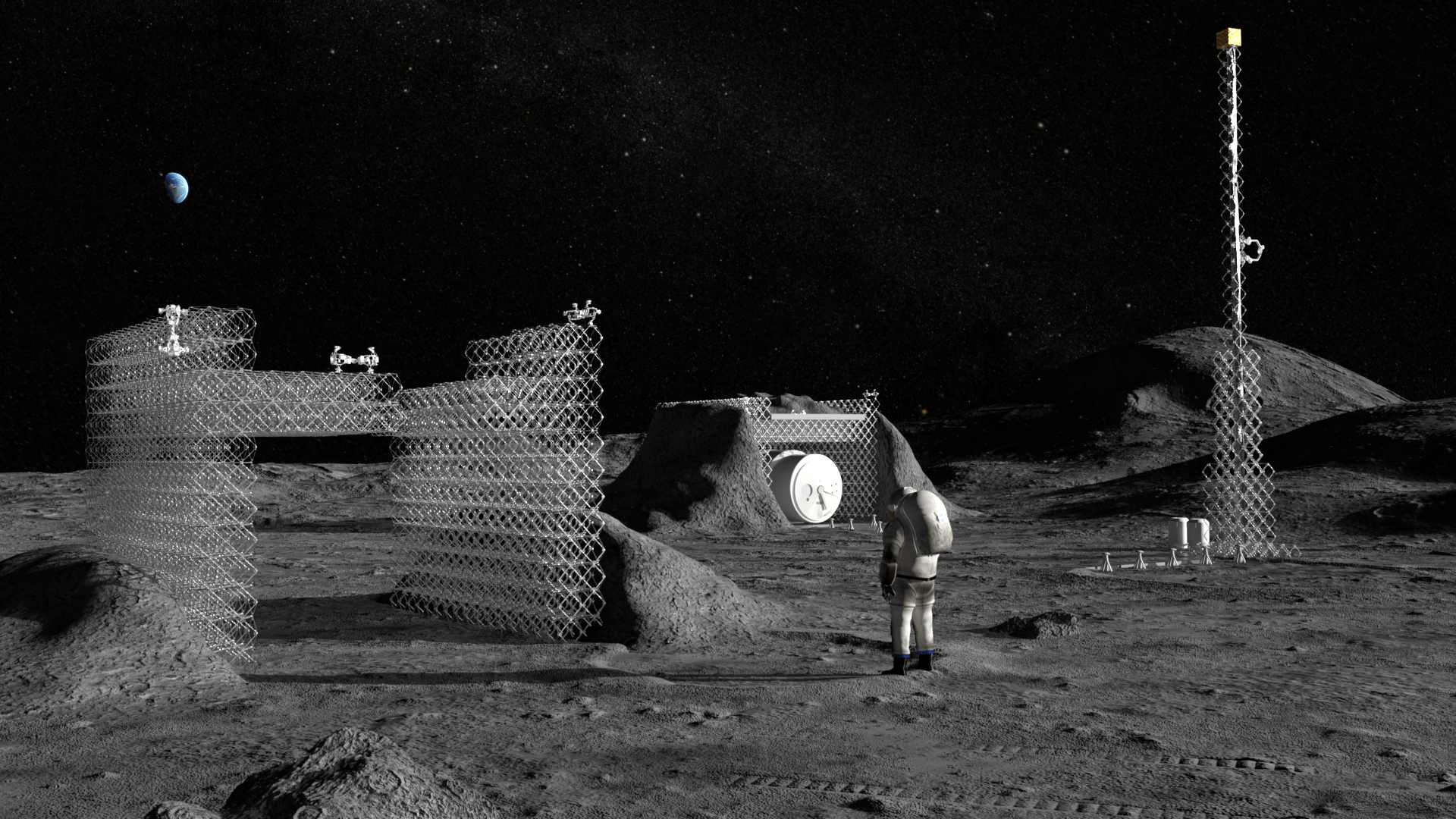
Conceptual illustration of ARMADAS building under astronaut supervision. Image Credits: NASA

Versions of the robot have already flown into space and done work in microgravity, so don’t worry on that score. And there is nothing in principle to prevent them from working at non-terrestrial gravities such as the moon. That said, this is just the beginning – like revealing the existence of 2x4s and nails. There’s more on the possibilities and conceptual renderings of what they could create, in this NASA news post.

“The next versions of our robots for the laboratory environment will be faster and more reliable, based on our lessons from the first versions. We are very interested in understanding how different types of building blocks can be incorporated into structures to provide functional equipment,” Gregg said.

Likewise, research will continue into structures that use swarms of robots, not just a handful. A crude shelter can last two walkers four days, but something 10 times larger can last 100 times longer. But many hands – especially robotic ones – make the light effect.

construction NASA NASAs phase robot robotic selfassembling Space structures
Share. Facebook Twitter Pinterest LinkedIn Tumblr Email
Previous ArticleApple to release iOS 17.3 next week, bringing Stolen Device Protection, collaborative playlists
Next Article Flexport taps Shopify for cash, behind the wheel of the Kia EV9 and where Amazon wants to invest
bhanuprakash.cg
techtost.com
  • Website

Related Posts

Trump’s AI executive order promises ‘a rulebook’ – startups may find legal loophole instead

13 December 2025

Ok, so what’s up with the LinkedIn algo?

12 December 2025

Google Released Its Deepest Research AI Agent To Date — The Same Day OpenAI Dropped GPT-5.2

12 December 2025
Add A Comment

Leave A Reply Cancel Reply

Don't Miss

Eclipse Energy’s microbes can turn dormant oil wells into hydrogen factories

13 December 2025

Inside Rivian’s big bet on self-driving with artificial intelligence

13 December 2025

DoorDash driver faces felony charges after allegedly spraying customers’ food

13 December 2025
Stay In Touch
  • Facebook
  • YouTube
  • TikTok
  • WhatsApp
  • Twitter
  • Instagram
Fintech

Coinbase starts onboarding users again in India, plans to do fiat on-ramp next year

7 December 2025

Walmart-backed PhonePe shuts down Pincode app in yet another step back in e-commerce

5 December 2025

Nexus stays out of AI, keeping half of its new $700M fund for India startup

4 December 2025
Startups

Eclipse Energy’s microbes can turn dormant oil wells into hydrogen factories

Interest in Spoor’s AI bird tracking software is soaring

Retro, a photo-sharing app for friends, lets you ‘time travel’ to your camera roll

© 2025 TechTost. All Rights Reserved
  • About Us
  • Contact Us
  • Privacy Policy
  • Terms and Conditions
  • Disclaimer

Type above and press Enter to search. Press Esc to cancel.