

Close Menu
TechTost
  • AI
  • Apps
  • Crypto
  • Fintech
  • Hardware
  • Media & Entertainment
  • Security
  • Startups
  • Transportation
  • Venture
  • Recommended Essentials
What's Hot

Why China’s humanoid robot industry is winning the early market

Google launches Nano Banana 2 model with faster image generation

Xiaomi launches 17 Ultra smartphones, an AirTag clone and an ultra-thin powerbank

Facebook X (Twitter) Instagram
  • About Us
  • Contact Us
  • Privacy Policy
  • Terms and Conditions
  • Disclaimer
Facebook X (Twitter) Instagram
TechTost
Subscribe Now
  • AI

    Musk slams OpenAI in deposition, says ‘no one killed themselves because of Grok’

    28 February 2026

    Pentagon moves to designate Anthropic as a supply chain risk

    28 February 2026

    Anthropic CEO stands firm as Pentagon deadline looms

    27 February 2026

    Jack Dorsey just halved the size of Block’s employee base — and he says your company is next

    27 February 2026

    Salesforce CEO Marc Benioff: This isn’t our first SaaSpocalypse

    26 February 2026
  • Apps

    Google launches Nano Banana 2 model with faster image generation

    1 March 2026

    South Korea is opening the door to allow Google Maps to be fully operational

    28 February 2026

    Spotify releases audiobook maps

    28 February 2026

    Bumble adds AI photo feedback and profile guidance tools

    27 February 2026

    Threads is testing a shortcut to quickly start DM conversations

    27 February 2026
  • Crypto

    Hackers stole over $2.7 billion in crypto in 2025, data shows

    23 December 2025

    New report examines how David Sachs may benefit from Trump administration role

    1 December 2025

    Why Benchmark Made a Rare Crypto Bet on Trading App Fomo, with $17M Series A

    6 November 2025

    Solana co-founder Anatoly Yakovenko is a big fan of agentic coding

    30 October 2025

    MoviePass opens Mogul fantasy league game to the public

    29 October 2025
  • Fintech

    3 days left: Save up to $680 on your ticket to Disrupt 2026

    25 February 2026

    More startups surpass $10M ARR in 3 months than ever before

    24 February 2026

    Stripe, PayPal Ventures Bet on India’s Xflow to Fix Cross-Border B2B Payments

    24 February 2026

    InScope raises $14.5M to solve financial reporting pain

    20 February 2026

    OpenAI deepens India push with Pine Labs fintech partnership

    19 February 2026
  • Hardware

    Xiaomi launches 17 Ultra smartphones, an AirTag clone and an ultra-thin powerbank

    28 February 2026

    Last 24 hours to get Disrupt 2026 tickets at the lowest prices of the year

    27 February 2026

    Everything announced at Samsung’s Galaxy Unpacked event, including S26 smartphones, privacy screen and more

    26 February 2026

    Samsung introduces new display technology that adds a privacy screen to apps and notifications

    25 February 2026

    Oura launches a proprietary AI model focused on women’s health

    25 February 2026
  • Media & Entertainment

    Apple and Netflix team up to stream Formula 1 Canadian Grand Prix

    27 February 2026

    Netflix pulls out of bid for Warner Bros. Discovery, giving studios, HBO and CNN to Ellison-owned Paramount

    27 February 2026

    Book the best deals for Disrupt 2026 | TechCrunch

    26 February 2026

    Americans now listen to podcasts more often than talk radio, study shows

    25 February 2026

    Music producer ProducerAI joins Google Labs

    25 February 2026
  • Security

    The resulting data breach is growing, affecting at least 25 million people

    28 February 2026

    India cuts off access to popular developer platform Supabase with block order

    28 February 2026

    CISA replaces deputy director after a difficult year on the job

    27 February 2026

    Cisco Says Hackers Are Exploiting Critical Flaw To Break Into Large Customer Networks By 2023

    26 February 2026

    US cybersecurity agency CISA reportedly in dire straits amid Trump cuts and layoffs

    26 February 2026
  • Startups

    Why China’s humanoid robot industry is winning the early market

    1 March 2026

    Jest, a marketplace for messaging games, is challenging the app store status quo

    28 February 2026

    Superhuman bets on redesigned smart ring to win back US market after Oura controversy

    27 February 2026

    Trace raises $3 million to solve AI agent adoption in the enterprise

    27 February 2026

    How to avoid bad hires in early stage startups

    26 February 2026
  • Transportation

    Self-driving truck startup Einride raises $113M PIPE ahead of public debut

    27 February 2026

    It’s time to pull the plug on plug-in hybrids

    26 February 2026

    Harbinger acquires self-driving company Phantom AI

    26 February 2026

    Waymo robotaxis are now operating in 10 US cities

    25 February 2026

    Self-driving tech startup Wayve raises $1.2 billion from Nvidia, Uber and three automakers

    25 February 2026
  • Venture

    After Zomato, Deepinder Goyal is back with a $54 million brain-monitoring bet

    28 February 2026

    Dive into Boston’s startup ecosystem at Founder Summit 2026 | TechCrunch

    27 February 2026

    A VC and some big-name developers are trying to solve the open source funding problem, permanently

    27 February 2026

    Y Combinator grad and AI insurance brokerage Harper raises $47 million

    26 February 2026

    Anthropic acquires AI startup Vercept after Meta indicts one of its founders

    26 February 2026
  • Recommended Essentials
TechTost
You are at:Home»Hardware»Shinkei’s humane fish harvesting technology that maintains quality could revolutionize the seafood industry
Hardware

Shinkei’s humane fish harvesting technology that maintains quality could revolutionize the seafood industry

techtost.comBy techtost.com2 May 202405 Mins Read
Share Facebook Twitter Pinterest LinkedIn Tumblr Email
Shinkei's Humane Fish Harvesting Technology That Maintains Quality Could Revolutionize
Share
Facebook Twitter LinkedIn Pinterest Email

Harvesting fish is an inherently messy business, as with being in the sea, slithery creatures hanging around and all. Shinkei is working to improve this with an automated system that ships fish more humanely and reliably, resulting in a completely different seafood economy.

In many fishing vessels, fish are left to suffocate on the deck, fall and injure themselves, resulting in a greater chance of bacterial contamination, shorter shelf life and poorer taste.

A Japanese technique called ike-jime is an alternative, essentially amounting to a spike through the brain rather than a tedious, messy death. But it takes a certain amount of expertise and one person can only handle so many fish. That’s where Shinkei comes in: it automates the process so the fish don’t suffer and the resulting meat lasts longer and is of better quality.

When I last spoke with the company in 2022, it was developing its first prototypes of vessels to be tested in the unpredictable marine environment. The machine holds the fish in place, identifies the species and shape, and from there can determine exactly where the brain is, which it ejects quickly and accurately. This is the end of the fish, although it still needs to be bled, which happens immediately afterwards in an ice bath.

Founder Saif Khawaja told me that since then, Shinkei has improved its machines to be more reliable, moving from a water-based to a mechanical one, along with other improvements one makes when going from a prototype to a production unit .

The improved machines can also be connected in a modular fashion, allowing parallel processing streams, while the computer vision stack that analyzes the fish in the block is improved, with the addition of new types of fish.

And of course the company has raised money: $6 million to help it go from pilot to production. The goal is to have 10 machines in real use by the end of the year. Shinkei is also working on a second machine that performs a second operation, effectively destroying the spinal cord so that there is no trace of the central nervous system—one step closer to a fillet.

A prototype Shinkei machine on a fishing boat, left. Co-founder Saif Khawaja, right. Image Credits: Shinkei

Khawaja sees Shinkei, and the automation of this technique and ike-jime, as potentially the beginning of a major shift in the seafood economy. It’s not just that he’s hoping for a more humane harvesting method to be implemented – there are a number of negative effects that could be far-reaching.

The thing about the seafood industry is that there is a huge amount of waste, no doubt in part because the oceans are seen as an inexhaustible resource. It’s not, by the way! And overfishing is driving many fish to effective extinction.

Part of that waste is that fish simply don’t last long as a high-quality product. We’ve all seen the signs: fish, purchase price, delivery this morning. Because tomorrow, that fish will only be good enough to be served grilled with sauce or in a salad, and the next day it’s compost or animal feed.

Consumers and restaurants accept this the way we once accepted that milk had to be delivered every few days because it went bad. When packaging technology made it possible for milk to last for weeks rather than days, it changed our relationship with it. Likewise, when in the 1970s, humane slaughter of cows was mandated by the FDA, this became the new standard, including the costs and supply chain changes that entailed.
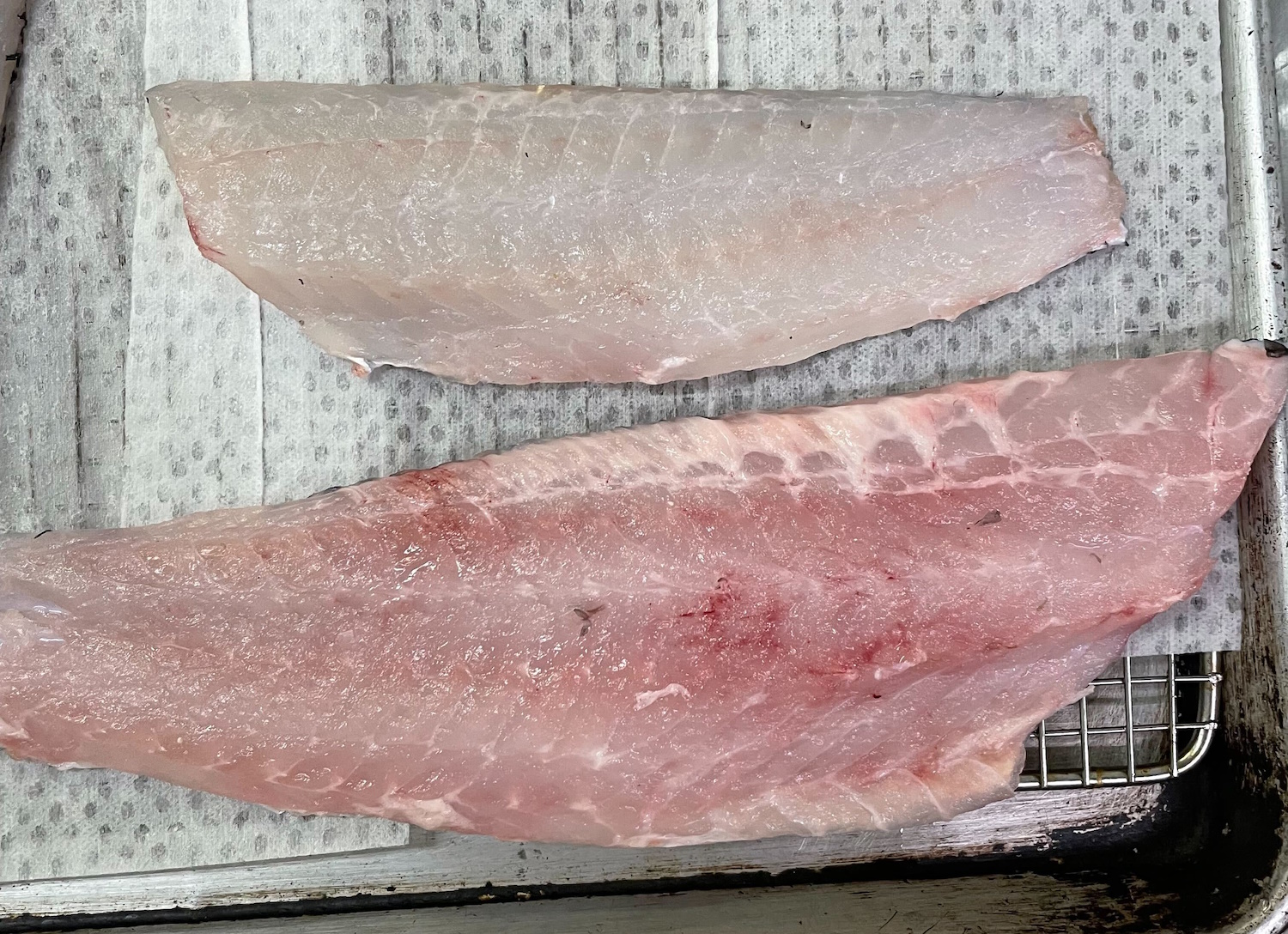
A fish harvested using the Shinkei system, top, and traditional, bottom — showing tissue damage and contamination that will lead to faster spoilage. Image Credits: Shinkei

Khawaja hopes a similar transformation is underway in seafood. Fish killed through ike-jime rather than other means last much longer, retaining their peak flavor and texture for perhaps a week instead of a day or two. The whole deconstruction process slows down.

This means that a restaurant may not need to buy as much fish, a quarter of which will perhaps be thrown away, but will pay more for fewer, higher-quality fish that last longer. This kind of shift can cause entire industries to change.

For example, in recent decades we have seen a huge amount of meat processing work shift overseas. Khawaja reported that only one billion pounds of salmon were sent to China for processing because it doesn’t make economic sense to do it here where people demand higher wages.

If the value of an individual fish increases and it is easier to process it locally, this may make the economics of processing it overseas (kind of ridiculous to begin with) no longer make sense. Fish can be caught here and stay here, as well as all jobs related to the industry.

Higher value fish can also put negative pressure on overfishing. If a boat can make the same money on 700 fish as it once did on 1,000, that also changes things. Fewer vessels will need to collect far beyond legal or ethical levels just to survive as a business.

“This is a net efficiency gain for the entire supply chain,” Khawaja said. “I really think that in seafood the problems are particularly acute and many of these jobs are dangerous. I worked as a deckhand and almost died! I don’t want this to be a fully automated supply chain, but to remove dangerous jobs and let the skilled workforce create their new environment.”

The funding round was led by Cantos, along with 8VC, Impatient Ventures, Susa Ventures, Carya Venture Partners, Ravelin Capital, Red & Blue Ventures, Undeterred Capital and existing investors.

Cantos Ventures fish Fishing harvesting Humane industry Maintains quality revolutionize seafood shinkei Shinkeis technology
Share. Facebook Twitter Pinterest LinkedIn Tumblr Email
Previous ArticleIt sounds like it’s being tested using Prime Video data for audiobook recommendations as the Spotify competition heats up
Next Article TikTok Brings Tay and Billie Back With New UMG Content Licensing Deal
bhanuprakash.cg
techtost.com
  • Website

Related Posts

Why China’s humanoid robot industry is winning the early market

1 March 2026

Xiaomi launches 17 Ultra smartphones, an AirTag clone and an ultra-thin powerbank

28 February 2026

Pentagon moves to designate Anthropic as a supply chain risk

28 February 2026
Add A Comment

Leave A Reply Cancel Reply

Don't Miss

Why China’s humanoid robot industry is winning the early market

1 March 2026

Google launches Nano Banana 2 model with faster image generation

1 March 2026

Xiaomi launches 17 Ultra smartphones, an AirTag clone and an ultra-thin powerbank

28 February 2026
Stay In Touch
  • Facebook
  • YouTube
  • TikTok
  • WhatsApp
  • Twitter
  • Instagram
Fintech

3 days left: Save up to $680 on your ticket to Disrupt 2026

25 February 2026

More startups surpass $10M ARR in 3 months than ever before

24 February 2026

Stripe, PayPal Ventures Bet on India’s Xflow to Fix Cross-Border B2B Payments

24 February 2026
Startups

Why China’s humanoid robot industry is winning the early market

Jest, a marketplace for messaging games, is challenging the app store status quo

Superhuman bets on redesigned smart ring to win back US market after Oura controversy

© 2026 TechTost. All Rights Reserved
  • About Us
  • Contact Us
  • Privacy Policy
  • Terms and Conditions
  • Disclaimer

Type above and press Enter to search. Press Esc to cancel.