

Close Menu
TechTost
  • AI
  • Apps
  • Crypto
  • Fintech
  • Hardware
  • Media & Entertainment
  • Security
  • Startups
  • Transportation
  • Venture
  • Recommended Essentials
What's Hot

Money transfer app Duc has exposed thousands of driver’s licenses and passports to the open web

Different teams start with different VCs

Tesla’s cheaper vehicles aren’t helping its declining sales

Facebook X (Twitter) Instagram
  • About Us
  • Contact Us
  • Privacy Policy
  • Terms and Conditions
  • Disclaimer
Facebook X (Twitter) Instagram
TechTost
Subscribe Now
  • AI

    Salesforce announces a heavy overhaul for Slack, with 30 new features

    2 April 2026

    Meta’s gas glut could power South Dakota

    2 April 2026

    Anthropic is one month old

    1 April 2026

    Mercor Says It Was Hit By Cyber ​​Attack Linked To Compromise Of LiteLLM Open Source Project

    1 April 2026

    With its new app store, Ring bets on artificial intelligence to overcome home security

    31 March 2026
  • Apps

    Exclusive: Beehiiv expands into podcasting, targeting Patreon

    2 April 2026

    A new dating app, Sonder, has a deliberately annoying sign-up process (and it works)

    2 April 2026

    Truecaller Caller ID app reaches 500 million monthly users

    1 April 2026

    Go play this secret game in the TikTok DMs

    1 April 2026

    Speechify’s Windows app uses local models for transcription and dictation

    31 March 2026
  • Crypto

    Hackers stole over $2.7 billion in crypto in 2025, data shows

    23 December 2025

    New report examines how David Sachs may benefit from Trump administration role

    1 December 2025

    Why Benchmark Made a Rare Crypto Bet on Trading App Fomo, with $17M Series A

    6 November 2025

    Solana co-founder Anatoly Yakovenko is a big fan of agentic coding

    30 October 2025

    MoviePass opens Mogul fantasy league game to the public

    29 October 2025
  • Fintech

    Doss raises $55 million for AI inventory management that connects to ERP

    24 March 2026

    Despite stiff competition, Kalshi, Polymarket CEOs back $35m VC fund projections

    23 March 2026

    Amid legal turmoil, Kalshi is temporarily banned in Nevada

    20 March 2026

    Nominations for the Startup Battlefield 200 are still open

    19 March 2026

    Kalshi’s legal woes pile up as Arizona files first criminal charges for ‘illegal gambling operation’

    17 March 2026
  • Hardware

    Nothing’s AI device design reportedly includes smart glasses and headphones

    2 April 2026

    Cognichip wants AI to design the chips that power AI, and it just raised $60 million to test

    2 April 2026

    Meta launches two new Ray-Ban glasses designed for prescription wearers

    1 April 2026

    Whoop’s valuation just tripled to $10 billion

    1 April 2026

    The Pixel 10a doesn’t have a camera bump, and it’s great

    30 March 2026
  • Media & Entertainment

    Roku is launching a standalone app for Howdy, its $2.99 ​​streaming service

    31 March 2026

    SXSW is making a comeback as a premier networking, ideas festival for founders and VCs

    30 March 2026

    ‘Project Hail Mary’ becomes Amazon MGM’s biggest box office hit

    30 March 2026

    Sora’s shutdown could be a reality check moment for video AI

    29 March 2026

    Netflix confirms it’s raising prices again

    27 March 2026
  • Security

    Money transfer app Duc has exposed thousands of driver’s licenses and passports to the open web

    2 April 2026

    Apple releases security patch for older iPhones and iPads to protect against DarkSword attacks

    2 April 2026

    WhatsApp is alerting hundreds of users who installed a fake app made by a government-run spyware maker

    1 April 2026

    Health data giant CareCloud says hackers accessed patient medical records

    1 April 2026

    North Korean hackers accused of hijacking popular open source project Axios to spread malware

    31 March 2026
  • Startups

    Different teams start with different VCs

    2 April 2026

    YC’s troubled startup Delve’s reputation just got worse

    2 April 2026

    StrictlyVC San Francisco is less than a month away

    1 April 2026

    It’s not your imagination: AI startups have higher valuations

    1 April 2026

    The company behind ClassPass and Mindbody just got a lot bigger with a $7.5 billion merger

    31 March 2026
  • Transportation

    Tesla’s cheaper vehicles aren’t helping its declining sales

    2 April 2026

    The Rivian spinoff will also build autonomous delivery vehicles for DoorDash

    2 April 2026

    Uber and WeRide are ramping up robotaxi operations in Dubai

    1 April 2026

    Robotaxi companies decline to say how often their AVs need remote assistance

    1 April 2026

    TechCrunch Mobility: When a robotaxi needs to call 911

    30 March 2026
  • Venture

    Toyota’s Woven Capital appoints new CIO and COO in push to find ‘future of mobility’

    1 April 2026

    Exclusive: Runway Launches $10M Fund, Builders Program to Back Early-Stage AI Startups

    31 March 2026

    Former Coatue Partner Raises Massive $65M Seed Fund for Enterprise AI Agent Startup

    31 March 2026

    From Moon Hotels to Cattle Grazing: 8 Startup Investors Hunted at YC Demo Day

    28 March 2026

    16 of the most interesting startups from the YC W26 Demo Day

    27 March 2026
  • Recommended Essentials
TechTost
You are at:Home»Hardware»The phone is dead. Long live. . . what exactly
Hardware

The phone is dead. Long live. . . what exactly

techtost.comBy techtost.com31 December 202506 Mins Read
Share Facebook Twitter Pinterest LinkedIn Tumblr Email
The Phone Is Dead. Long Live. . . What Exactly
Share
Facebook Twitter LinkedIn Pinterest Email

True Ventures co-founder Jon Callaghan doesn’t think we’ll be using smartphones the way we do now in five years — and maybe not at all in 10.

For a venture capitalist whose company has had some big winners over its two decades — from consumer brands like Fitbit, Ring and Peloton, to business software makers HashiCorp and Duo Security — this is more than armchair theorizing. is a thesis that True Ventures is actively betting on.

True hasn’t gotten that far by following the crowd. The Bay Area firm has operated largely under the radar despite managing about $6 billion in 12 core funds and four “selected” opportunity-style funds that it has used to allocate more capital to portfolio companies that are gaining momentum. While other VCs have become more promotional – creating personal brands on social media and podcasts to attract founders and the deal flow – True has gone in the opposite direction, quietly cultivating a tight network of repeat founders. The strategy seems to be working: according to Callaghan, the company boasts 63 profitable exits and seven IPOs amid a portfolio of about 300 companies amassed over its 20-year history.

Three of True’s four recent exits in the fourth quarter of 2025 involved repeat founders who returned to work with the company after previous successes, Callaghan says. However, it’s Callaghan’s thinking about the future of human-computer interaction that really stands out in a sea of ​​AI hype and big circles.

“We’re not going to be using iPhones in 10 years,” Callaghan says flatly. “I don’t think we’ll be using them in five years – or let’s say something different that’s a bit safer – we’ll be using them in very different ways.”

His argument is simple: our phones are lousy at being the interface between humans and intelligence. “The way we’re taking them out right now to send a message to confirm it or send you a text or write an email – [that’s] extremely inefficient, [and] it’s not a great interface,” he explains.[They’re] prone to error, prone to disturbance [of] our normal life.”

He’s so sure of it that True has spent years exploring alternative interfaces – software-based, hardware-based, everything in between. It’s the same instinct that led True to bet early on Fitbit before wearables were obvious, invest in Peloton after hundreds of other VCs said “no thanks” and back Ring when founder Jamie Siminoff kept running out of money, even the judges on “Shark Tank.” turned him away. Each time, the bet seemed dubious, Callaghan says. Each time, the bet was on a new way for people to interact with technology that was more natural than before.

Techcrunch event

San Francisco
|
13-15 October 2026

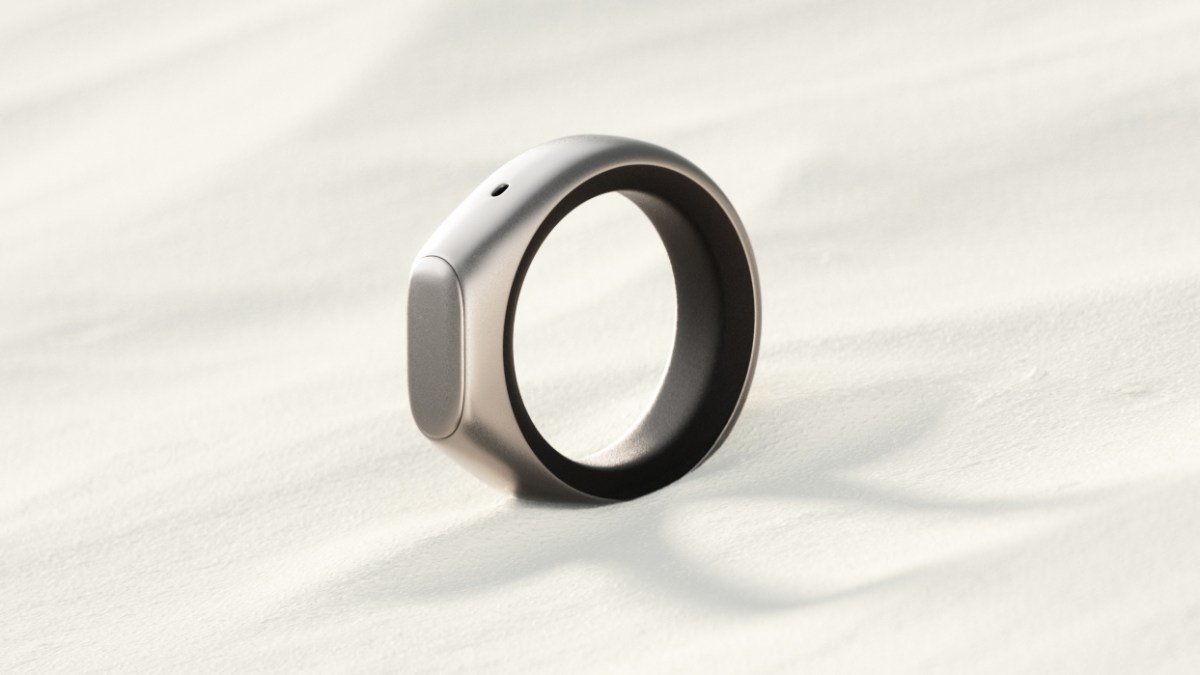
The latest manifestation of this thesis is the Sandbar, a hardware device that Callaghan describes as a “thought companion”—or, in more mundane terms, a voice-activated ring worn on the index finger. Its sole purpose: to record and organize your thoughts through voice memos. It’s not trying to be another Humane AI Pin or compete with Oura’s health monitoring. “He does one thing really well,” says Callaghan. “But that one thing is a fundamental human behavioral need that’s missing from technology today.”

The idea is not to passively record background sound, but to be there when an idea occurs, serving as a kind of thought partner. It’s connected to an app, leverages artificial intelligence and, according to Callaghan, represents a very different philosophy of how we should interact with intelligence.

What drew True to Sandbar founders Mina Fahmi and Kirak Hong wasn’t just the product. “When we met Mina, we were completely aligned with the vision,” recalls Callahan. The True team had already been thinking about alternative interfaces for years, making targeted investments around this possibility. They had met with dozens of founders as a result. But the approach of Fahmi and Hong – who previously collaborated on neural interfaces at CTRL-Labs, a startup acquired by Meta in 2019 – stood out. “It’s about what [the ring] allows. It’s about the behavior that enables us to realize very soon that we can’t live without it.”

There’s an echo here of Callahan’s old line about Peloton: “It’s not about the bike.” For some, the bike – even its first iteration – was exciting. But Peloton was really about the behavior it enabled and the community it created. the bike was just the vessel.

This philosophy of betting on new behaviors—not just new gadgets—also explains how True has managed to stay disciplined about capital. Even as AI startups raise hundreds of millions at billion-dollar valuations, True insists he’s able to stick to what he does best, which is writing initial $3 million to $6 million checks for 15 percent to 20 percent ownership in startups he often sees first.

Callaghan says True will raise more money to fund what works, but he’s not interested in raising billions of dollars. “Well, why? You don’t need it to make something amazing today.”

That same measured approach colors his view of the broader AI boom. While he says (when asked) that he thinks OpenAI could soon be worth a trillion dollars, and while he calls this the most powerful computing wave we’ve seen, Callaghan sees warning signs in the circular financing deals that support hyperscalers and $5 trillion in projected CapEx spending on data centers and chips. “We’re in a very intense part of the cycle and that’s worrying,” he notes.

That said, he’s optimistic about where the real opportunities lie. Callaghan believes the greatest value creation lies ahead – not at the infrastructure level but at the application level, where new interfaces will enable entirely new behaviors.

It all comes back to his core investment philosophy, which sounds almost romantic—the kind of pitch-perfect VC wisdom that would ring hollow with most people: “It should be scary and lonely and people call you crazy,” Callaghan says of early-stage investing done right. “And it should be really blurry and ambiguous, but you should be with a team that you really believe in.” Five to ten years later, he says, you’ll know if you did something.

Either way, based on True’s history of betting on hardware that many others have missed out on – fitness trackers, connected bikes, smart doorbells and now thought-provoking ringtones – it’s worth paying attention when Callaghan says the phone’s days are numbered. Being early is what it’s all about – and the trend lines support his thesis: the smartphone market is essentially saturated, growing at just 2% a year, while wearables – smartwatches, rings and voice-enabled devices – are expanding at double-digit rates.

Something is changing in the way we want to interact with technology, and True is placing its bets accordingly.

Pictured above, Sandbar’s Stream ring. For much more from our conversation with Callaghan, tune in to Download StrictlyVC podcast next week. new episodes drop every Tuesday.

Dead fitbit HashiCorp John Callaghan live long phone Platoon Real Businesses Ring
Share. Facebook Twitter Pinterest LinkedIn Tumblr Email
Previous ArticleThe Top 26 Consumer/edtech Companies from the Disrupt Startup Battlefield
Next Article Here’s what you need to know about the US TikTok deal
bhanuprakash.cg
techtost.com
  • Website

Related Posts

Nothing’s AI device design reportedly includes smart glasses and headphones

2 April 2026

Cognichip wants AI to design the chips that power AI, and it just raised $60 million to test

2 April 2026

Meta launches two new Ray-Ban glasses designed for prescription wearers

1 April 2026
Add A Comment

Leave A Reply Cancel Reply

Don't Miss

Money transfer app Duc has exposed thousands of driver’s licenses and passports to the open web

2 April 2026

Different teams start with different VCs

2 April 2026

Tesla’s cheaper vehicles aren’t helping its declining sales

2 April 2026
Stay In Touch
  • Facebook
  • YouTube
  • TikTok
  • WhatsApp
  • Twitter
  • Instagram
Fintech

Doss raises $55 million for AI inventory management that connects to ERP

24 March 2026

Despite stiff competition, Kalshi, Polymarket CEOs back $35m VC fund projections

23 March 2026

Amid legal turmoil, Kalshi is temporarily banned in Nevada

20 March 2026
Startups

Different teams start with different VCs

YC’s troubled startup Delve’s reputation just got worse

StrictlyVC San Francisco is less than a month away

© 2026 TechTost. All Rights Reserved
  • About Us
  • Contact Us
  • Privacy Policy
  • Terms and Conditions
  • Disclaimer

Type above and press Enter to search. Press Esc to cancel.