


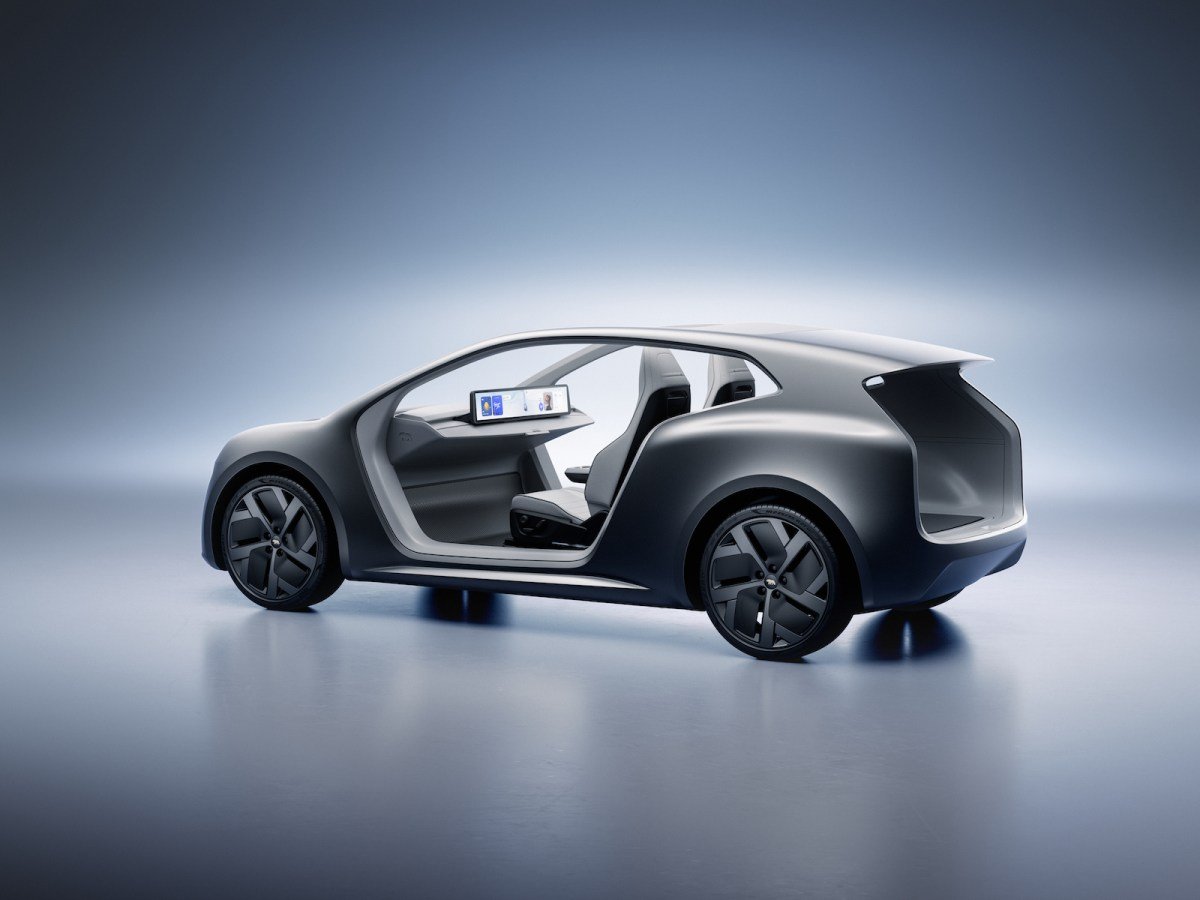
Lucid Motors unveiled a prototype robotaxi vehicle it calls the “Lucid Lunar,” which it unveiled at an investor day Thursday in New York.
It’s a two-seat vehicle without a steering wheel or pedals, designed to be built on the same underlying platform that Lucid Motors is developing for its upcoming line of “mid-size” electric vehicles, the company said.
Interim CEO Marc Winterhoff said that Lucid is already “working” on Lunar and that it will debut after the company launches its mid-sized vehicles, but the company later clarified to TechCrunch that there is no active development on the dedicated robotaxi — yet.
Lucid Motors also said Thursday it is close to a deal with Uber to collaborate on a robotaxi based on one of the midsize vehicles Lucid has in the works. Lucid Motors is currently working with autonomous vehicle company Nuro to build an autonomous version of the Gravity SUV that will roll out on Uber’s network by the end of this year in the San Francisco area. Nuro and Lucid have not confirmed whether this new vehicle will use Nuro’s technology.
The announcements came near the end of Lucid’s investor day, but show the company is increasingly focused on trying to build a business around autonomy that can complement its electric vehicle sales. At one point during the presentation, Lucid Motors showed a bar chart showing how it expects revenue from the robotaxi partnership to significantly eclipse the money it makes from licensing its electric vehicle technology, though there was no label on the Y-axis.
Lucid also wants to monetize its semi-autonomy game. The company revealed that it plans to offer monthly subscriptions for DreamDrive Pro that scale with increased capabilities starting in the first half of 2027. Owners can pay $69 a month for the lowest level of driver assistance or up to $199 a month for an autonomous driving feature that doesn’t require the driver to take over at all. (Lucid Motors has yet to develop this more advanced capability, nor has any other automaker, it should be noted.)
The company shared a slide on Thursday that said autonomy subscriptions “are the largest software monetization opportunity.” It’s something Tesla has been doing for a while with its Full Self-Driving (Supervised) software, and it’s a similar approach to what Rivian announced at its own “Autonomy & AI Day” in late December.
Techcrunch event
San Francisco, California
|
13-15 October 2026
Also, like Rivian, Lucid Motors is working on its own in-cabin AI assistant. The company aims to make the assistant capable of doing simple tasks like turning the air conditioning up or down, or handling complex queries like finding “something to do that’s a little bit unique, maybe off-road and maybe have a kind of nautical or nautical vibe.” It’s not clear how well it works right now. Lucid Motors’ attempt to demonstrate the assistant live during the event failed, and the company showed a pre-recorded video.
The rest of Lucid’s event focused heavily on the company’s efforts to lower the cost of manufacturing its vehicles, as well as its efforts to push the limits of electric powertrain performance. These will be critical elements in making the midsize vehicles affordable (supposed to start around $50,000) when the first one hits the market by the end of this year. The company revealed that one will be known as Lucid Cosmos and the second vehicle will be called Lucid Earth. The third name was not announced Thursday.
