


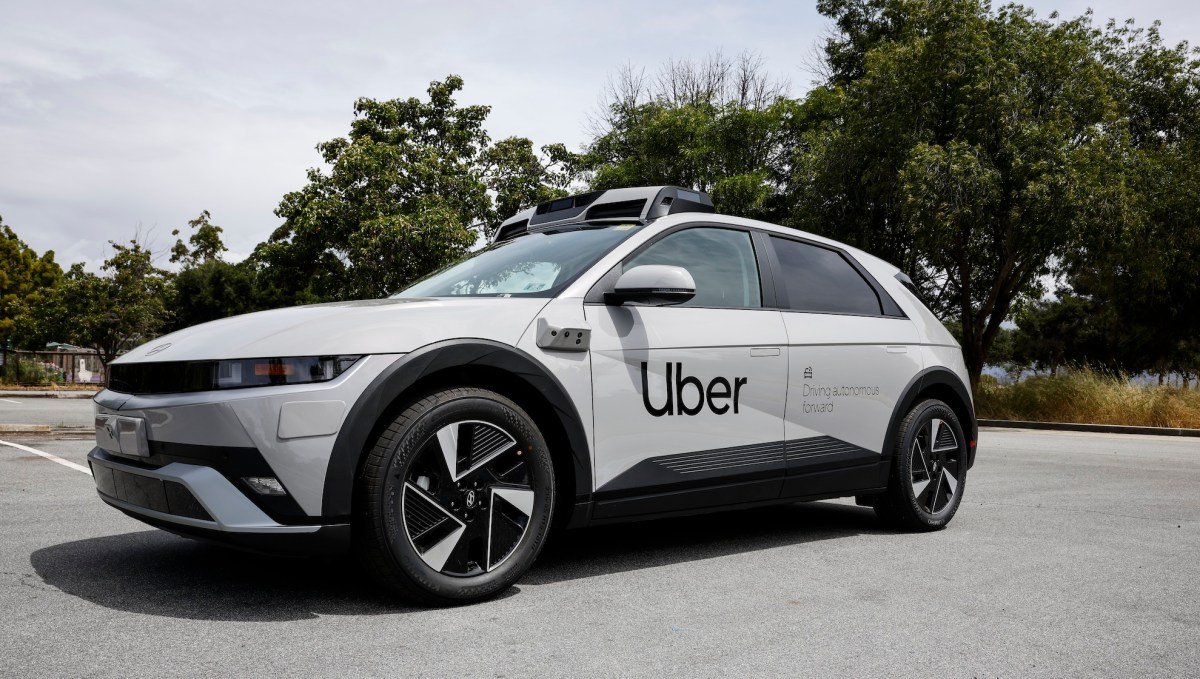
Uber on Wednesday unveiled a prototype car it plans to use to collect real-world driving data for its growing list of autonomous vehicle partners, including Avride, Waymo and WeRide.
The vehicle does not have any radical design. Rather, it’s a Hyundai Ioniq 5 equipped with an incredible number of sensors on the top and sides, as the company first told TechCrunch in January. The sensor-laden vehicle may not seem particularly groundbreaking, but it marks a few milestones for the company.
This is the first vehicle Uber has assembled (with the help of a partner) since the company sold its autonomous vehicle division to Aurora in 2020. It also represents progress on Uber’s new AV Labs division, which launched earlier this year to use sensor-equipped Uber cars to collect and then share data with 30 autonomous vehicle technology partners.
Uber said Wednesday it plans to roll out 500 of these Hyundai-equipped electrics worldwide this year. This fleet will be able to collect “2 million miles per month of high-fidelity data” for robotaxis. Uber expects 50 of these vehicles to be on the road by summer.
The Ioniqs are equipped with 14 cameras, eight solid-state lidar sensors and nine radars through a partnership with Roush Performance, which will handle the vehicle’s modifications. All of this data will be routed through Nvidia’s Dual Drive Thor autonomous vehicle computer. Uber seems open to changing this array of sensors, noting that it will continue to update it as its partners’ needs evolve.
However, this is not just a raw data transfer. Uber said its goal is to develop the world’s most geographically diverse training dataset specifically geared toward autonomous driving. If successful, this data set will give AV partners a stitched, time-synchronized 360-degree view that can be used to train self-driving software.
The company already has a lead. Uber told TechCrunch that it has collected data from thousands of vehicles equipped with outward facing cameras in dozens of cities operated by its fleet partners. Uber has also captured data from hundreds of Lucid Air vehicles used by its fleet partners in the US and Europe over the past two years.
Uber’s AV Labs division is analyzing these two batches of data and is preparing to collect even more with its modified Ioniq 5 vehicles, which will be used by its fleet partners.
The AV Labs division is one element of Uber’s broader ambitions for autonomous vehicles. The company in February launched a division called Uber Autonomous Solutions designed to handle the day-to-day operations of a robot, self-driving truck or curbside delivery robot business.
When you purchase through links in our articles, we may earn a small commission. This does not affect our editorial independence.
