


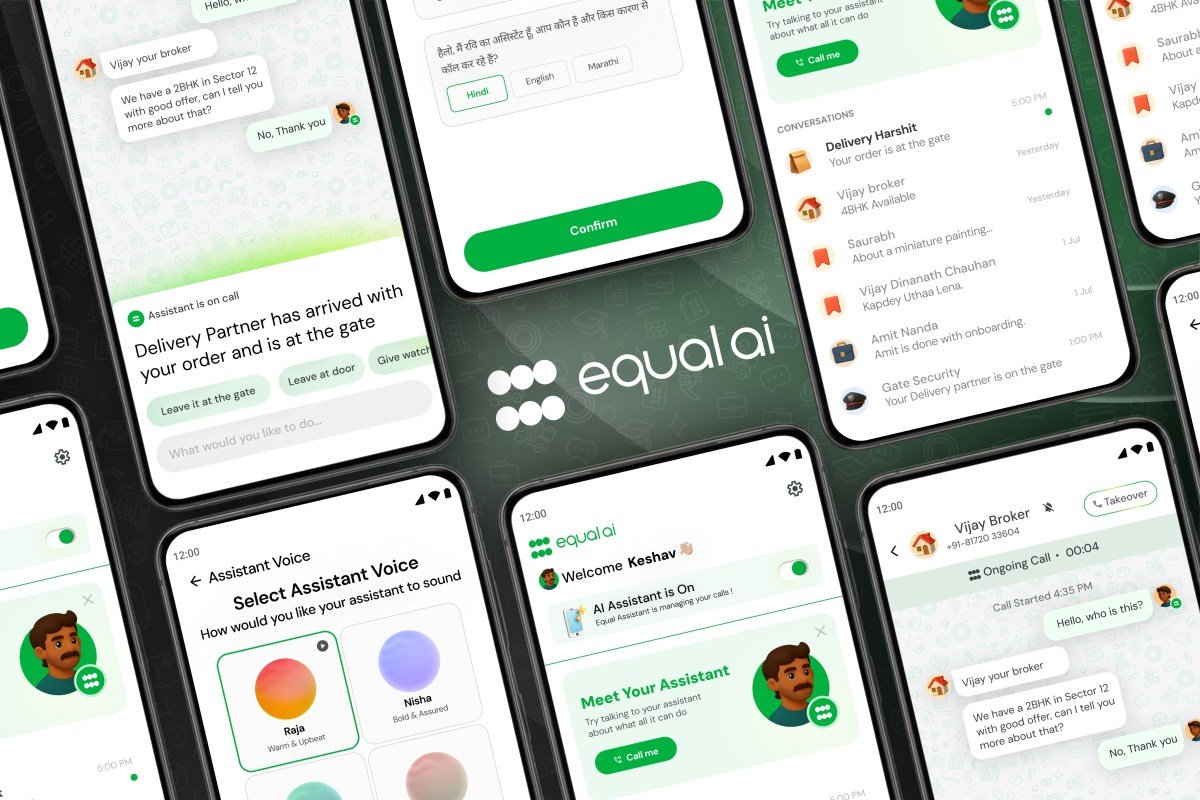
In India, consumers receive many calls every day, ranging from spam and scams to delivery people and financial services companies trying to contact them. There are apps like Truecaller and the government’s Calling Name Presentation (CNAP) system to identify who is calling, but knowing the caller’s name is often not enough. That’s why Equal AI creates an assistant that can take calls on your behalf, collect information and tell you why someone is calling you.
The app is currently available on Android and since its launch last year, has grown to more than a million monthly active users and over 300,000 daily active users, he says. The app displays the call and shows the reason someone is calling you.
The dialer displays quick response options like “Leave the delivery by the door” or “Give it to the neighbor” and the AI reads them to the caller. You can also type a custom message for the AI to read. The app records the call and users can view the recording and transcription history with a summary in the app.
Equal AI said today that it has raised $30 million in Series B funding led by Prosus Ventures and Tomales Bay Capital with participation from Think Investments and Valiant Fund. Individual investors include Indian fintech PhonePe founder Sameer Nigam, Zubin Bharti Mittal of Airtel Family Office, Skyflow AI co-founder Anshu Sharma, Meta India and Southeast Asia vice president Sandhya Devanathan and CtrlS Datacenters President Sridhar Pinnapureddy. With the new funding, the company has raised over $42 million to date.
The round is structured in three tranches, with the startup getting a different valuation at each stage depending on whether it hits predetermined targets — a growing but unusual approach in which startups sell shares at different prices in the same round. The structure has an unusual quirk: it allows a startup to advertise the highest valuation it has achieved, even if most of the stock was sold at a lower price. Equal AI declined to provide its specific valuations.
The startup was founded by Keshav Reddy in 2022. Reddy comes from the family behind Indian conglomerate GVK, which has holdings in infrastructure, energy and healthcare. Equal began as a data sharing company for financial services and continues to offer data for financial analysis and KYC services for employers.
“We’ve always wanted to be a customer-facing company, and with Equal AI, the first use case we launched was a call assistant because we realized that users get a lot of calls about financial services or job openings. If you’re buying car insurance, you might get 20 calls in a week, and that’s hard for a human to handle,” founder Reddy told TechCrunch.
The app currently only checks unknown calls, but the company plans to introduce the ability to check calls from known numbers as well. The company also wants the AI assistant to take proactive action on a user’s behalf — such as texting a delivery person at your address (with consent) or making outbound calls to set up an appointment. The startup said it is also working on an iOS version of the app and a paid subscription tier with more features.
Equal AI uses a combination of speech recognition, automatic speech recognition (ASR), and speech generation models with its own orchestration layer. English supports topics, but consumers in India often speak in their native language or combine multiple languages in one sentence – a phenomenon called code-mixing. Equal AI says it has built support for more than 10 languages with this in mind.
The startup has tough competition. Google and Apple have call monitoring products. Truecaller, already a household name in India, has built its own AI assistant capabilities. In the US, a16z-backed privacy startup Cloaked also launched call monitoring last year. Thiago Viana, global co-head of Prosus Ventures, said Equal’s understanding of the local context gives it an advantage.
“Equal AI promises to screen calls for you and provide context on why someone is calling. We believe that if an app does well in a few use cases, it can quickly become popular in its niche and build user stability to expand to different regions later,” Reddy told TechCrunch by phone.
Prosus has invested in AI assistant startups focused on local markets. Its portfolio includes Luzia based in Spain and Latin America Zapia. Both are involved in Meta’s ban on third-party AI bots on WhatsApp, which serves as a cautionary tale about platform dependency. Equal AI said it didn’t want to create that kind of dependency — that’s why it built around calls and its own app instead of piggybacking on a messaging platform.
When you purchase through links in our articles, we may earn a small commission. This does not affect our editorial independence.
