


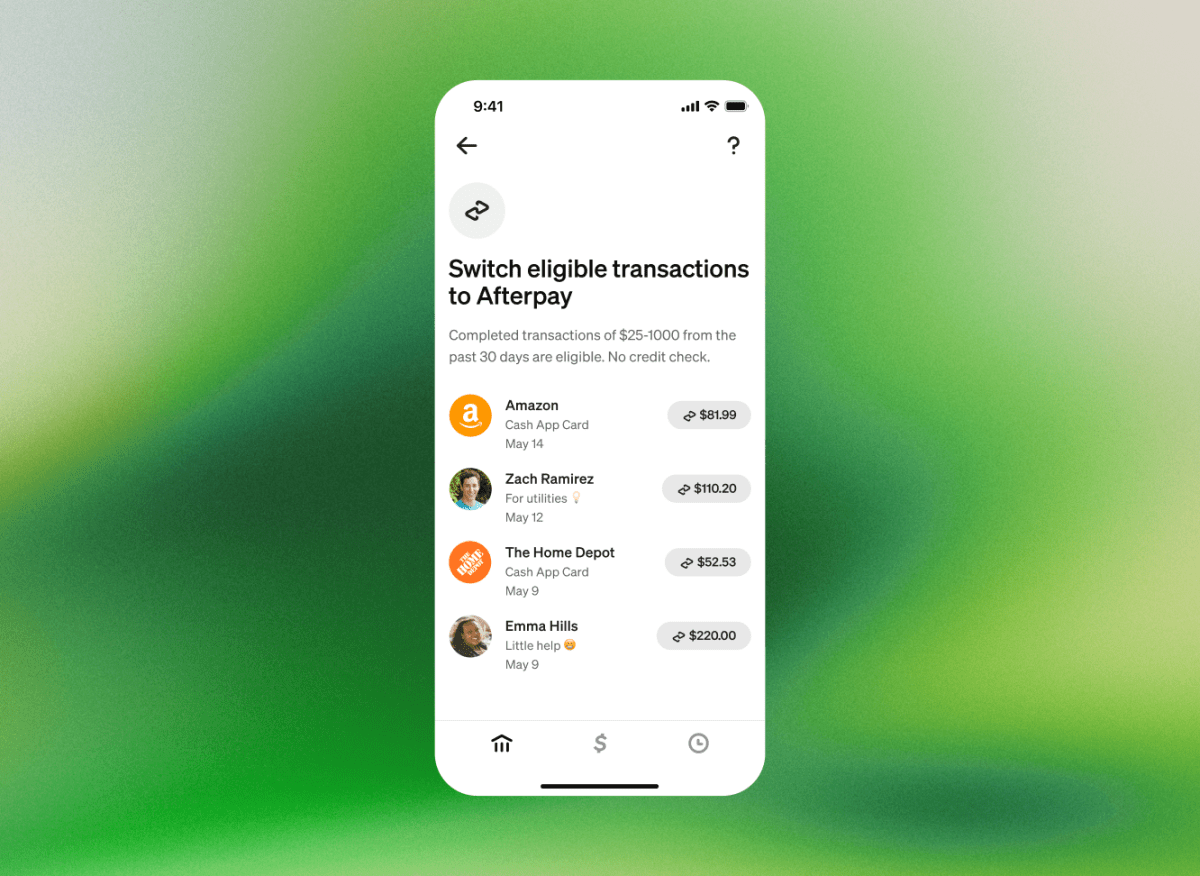
Cash App, the peer-to-peer fintech app owned by Jack Dorsey’s Block, has launched a new “pay over time” deferred payment feature that allows eligible users to pay for their daily transfers over an extended period of time.
Companies are increasingly offering deferred payments for relatively trivial and everyday purchases. About a year ago, DoorDash partnered with Klarna — allowing users to “microfinance” their food orders (the partnership specifically inspired a series of online jokes about “burrito debt” and late capitalism). The new feature of the Cash app clearly builds on this trend — expanding flexible financing into the realm of P2P payments.
To take advantage of the new feature, users pay a 7.5% fee — meaning if you borrow $100 from the Cash app, you’ll end up paying the company $107.50 back. Transfers of $25 or more are eligible, the company says, and repayments can be made in weekly increments over a period of up to six weeks or as one payment on the due date.
There are also loan limits in the new system, but they are dynamic — meaning they will be different for different users. “The specific amount available for conversion depends on the original transaction amount and individual customer rating,” a spokesperson said. “We assess each transaction for suitability against our responsible lending criteria rather than setting traditional credit limits,” they added.
In an interview, Block CEO and COO Owen Jennings framed the new feature as a way to add value to Cash App customers through “cash flow management.” Jennings noted that many Americans have different kinds of jobs today — many of which consistently pay less than those offered in previous decades. The new Cash App feature is designed to add financial flexibility to that situation, Jennings said.
“We’re seeing more people — especially younger people — who are solopreneurs, entrepreneurs… [and] gig workers. They have side hustles, multi-tasking, [and] so they have variable income streams,” Jennings said. “It’s very different than if you go back 40 or 50 years ago — I think the average income earner in the U.S. [back then] he basically got, like, a steady W2 income every two weeks.”
“Buy now, pay later” services have exploded in popularity in recent years, while also generating considerable criticism and concern. Some critics argue that such services are designed to trap consumers debt cycleswhile others have suggested that Americans who need to finance household staples are a a sign of a wider economic crisis. The companies that provide these services have also found themselves in legal hot water. Just this week, Klarna sued in a class-action lawsuit alleging it engaged in “predatory” practices, Bloomberg reports.
Techcrunch event
San Francisco, California
|
13-15 October 2026
Jennings said the new Cash App feature has strong built-in protections designed to keep users out of financial trouble, such as getting stuck in what he called “debt spirals.” “The way all our lending products are created is non-revolving,” he added. “If you don’t repay a loan, then you can’t get another loan.”
The service also builds on other financial flexibility services Cash App already offers, Jennings said. In previous years, the app made its debut Borrowwhich, somewhat like a traditional bank, allows users to take out a small loan from the app and then pay it back over a period of four to six weeks.
Another offer is Afterpay for Cash Application Card (its debit plan), which allows users to defer payments for card transactions.
