

Close Menu
TechTost
  • AI
  • Apps
  • Crypto
  • Fintech
  • Hardware
  • Media & Entertainment
  • Security
  • Startups
  • Transportation
  • Venture
  • Recommended Essentials
What's Hot

How SpaceX prompted a $2 billion fundraising with a $60 billion takeover offer

Elon Musk Admits Millions of Tesla Owners Need Upgrades for True ‘Full Self-Driving’

Esther and Anne Wojcicki support new healthcare accelerator, fund

Facebook X (Twitter) Instagram
  • About Us
  • Contact Us
  • Privacy Policy
  • Terms and Conditions
  • Disclaimer
Facebook X (Twitter) Instagram
TechTost
Subscribe Now
  • AI

    Tesla just increased its spending plan to $25 billion — this is where the money is going

    23 April 2026

    OpenAI partners with Infosys to bring AI tools to more businesses

    22 April 2026

    Unauthorized group gained access to Anthropic’s proprietary Mythos cyber tool, report claims

    22 April 2026

    NSA Spies Reportedly Using Anthropic’s Mythos, Despite Pentagon Controversy

    21 April 2026

    It’s not just one thing – it’s another thing

    21 April 2026
  • Apps

    Keep up with X’s new AI-powered custom streams

    23 April 2026

    X makes it more expensive to publish links through its API

    22 April 2026

    Apple’s Cal AI crackdown signals it still controls the App Store

    22 April 2026

    GRAI believes that AI can make music more social, not replace artists

    21 April 2026

    WhatsApp is testing a premium subscription, but it’s mostly cosmetic

    21 April 2026
  • Crypto

    British cryptographer Adam Back denies NYT report that he is Bitcoin creator Satoshi Nakamoto

    9 April 2026

    Hackers stole over $2.7 billion in crypto in 2025, data shows

    23 December 2025

    New report examines how David Sachs may benefit from Trump administration role

    1 December 2025

    Why Benchmark Made a Rare Crypto Bet on Trading App Fomo, with $17M Series A

    6 November 2025

    Solana co-founder Anatoly Yakovenko is a big fan of agentic coding

    30 October 2025
  • Fintech

    Cash App targets a new type of customer: children aged 6 to 12 years

    22 April 2026

    Revolut eyes up to $200 billion valuation in potential IPO

    22 April 2026

    Once close enough for a takeover, Stripe and Airwallex are now going after each other

    18 April 2026

    Airwallex is set to take on Stripe and the rest of the payments industry — in the physical world

    16 April 2026

    Cash app launches ‘pay later’ feature for P2P transfers

    3 April 2026
  • Hardware

    Apple’s John Ternus will run one of the most powerful companies in the world. work is a minefield

    22 April 2026

    Tim Cook steps down as Apple CEO: Here’s a look at his 15-year legacy, from new products and services to China expansion

    22 April 2026

    Who is John Ternus, the new CEO of Apple?

    21 April 2026

    Tim Cook steps down as Apple CEO, while John Ternus takes over

    21 April 2026

    Amazon Unveils Slimmer Fire TV Stick HD, Opens Ember Artline TVs for Pre-Order

    16 April 2026
  • Media & Entertainment

    YouTube extends its AI similarity detection technology to celebrities

    21 April 2026

    Deezer says 44% of songs uploaded to its platform every day are created with artificial intelligence

    20 April 2026

    Netflix plans to add a vertical video stream, use AI for recommendations

    17 April 2026

    Netflix co-founder and chairman Reed Hastings is stepping down from the board

    17 April 2026

    All we like is soulfulness

    16 April 2026
  • Security

    Apple fixes bug used by police to extract deleted chat messages from iPhones

    22 April 2026

    As US spy laws expire, lawmakers divided over protecting Americans from warrantless surveillance

    22 April 2026

    Ransomware dealer pleads guilty to helping ransomware gang

    21 April 2026

    App host Vercel says it was hacked and customer data stolen

    21 April 2026

    Mastodon says its flagship server has been hit by a DDoS attack

    20 April 2026
  • Startups

    How SpaceX prompted a $2 billion fundraising with a $60 billion takeover offer

    23 April 2026

    Cathie Woods’ ARK makes first major investment in startup Lucra — and it’s not AI

    22 April 2026

    AI research lab NeoCognition offers $40 million to build agents that learn like humans

    22 April 2026

    You’ve heard of hybrid cars. Now meet a hybrid cement plant.

    19 April 2026

    Loop raises $95 million to build supply chain artificial intelligence that predicts disruptions

    18 April 2026
  • Transportation

    Elon Musk Admits Millions of Tesla Owners Need Upgrades for True ‘Full Self-Driving’

    23 April 2026

    Redwood Materials lays off 10% in restructuring to pursue energy storage business

    22 April 2026

    Amazon taps Sweden’s Einride for its electric big rigs

    21 April 2026

    The Rivian factory was hit by a tornado before the R2 was released

    20 April 2026

    TechCrunch Mobility: Uber enters the era of assetmaxxing

    20 April 2026
  • Venture

    Esther and Anne Wojcicki support new healthcare accelerator, fund

    23 April 2026

    Anthropic rejects VC funding that values ​​it at $800B+, for now

    16 April 2026

    Financial risk management platform Pillar raises $20 million in rounds led by a16z

    15 April 2026

    Vercel CEO Guillermo Rauch signals IPO readiness as AI agents drive revenue

    14 April 2026

    Nvidia-backed SiFive hits $3.65 billion valuation for open AI chips

    11 April 2026
  • Recommended Essentials
TechTost
You are at:Home»Hardware»Microsoft and Quantinuum say they have ushered in the next era of quantum computing
Hardware

Microsoft and Quantinuum say they have ushered in the next era of quantum computing

techtost.comBy techtost.com6 April 202405 Mins Read
Share Facebook Twitter Pinterest LinkedIn Tumblr Email
Microsoft And Quantinuum Say They Have Ushered In The Next
Share
Facebook Twitter LinkedIn Pinterest Email

Microsoft and Quantinuum today was announced a breakthrough in quantum error correction. Using Quantinuum’s ion-trap hardware and Microsoft’s new qubit virtualization system, the team was able to run more than 14,000 experiments without a single error. This new system also allowed the team to test the logic qubits and fix any errors they encountered without destroying the logic qubits.

This, the two companies say, has now moved the state of the art of quantum computing out of what has commonly been called the era of noisy intermediate-scale quantum computing (NISQ). “Noisy” because even the smallest changes in the environment can cause a quantum system to become essentially random (or “decay”) and “intermediate scale” because the current generation of quantum computers is still limited to little more than a thousand qubits at best . A qubit is the fundamental unit of computation in quantum systems, analogous to a bit in a classical computer, but each qubit can be in many states at once and does not fall into a specific position until it is measured, which is the basis of the quantum possibility for to provide a huge leap in computing power.

It doesn’t matter how many qubits you have, however, if you don’t have time to run a basic algorithm before the system becomes too noisy to get a useful result — or any result at all.

By combining many different techniques, the team was able to run thousands of experiments with virtually no errors. This involved a lot of preparation and pre-selection of systems that already seemed to be in good shape for a successful run, but still, this is a huge improvement from where the industry was a while ago.

It’s a step in the right direction for quantum computing. There are still many problems to be solved (and these results need to be reproduced, of course), but in theory, a computer with 100 of these logical qubits could already be useful for solving some problems, while a machine with 1,000 qubits could, says Microsoft, “unlock commercial advantage.”

The deviations (errors) between entangled qubits. Discrepancies are revealed by comparing the images from each qubit in a pair, and any differences that exist are shown as dots in the central image between each pair. Image Credits: Microsoft

The team used Quantinuum’s Trapped Ion Processor H2 and was able to combine 30 physical qubits into four highly reliable logical qubits. Encoding multiple physical qubits into a single logical qubit helps protect the system from errors. Physical qubits are entangled with each other so that an error in a physical qubit can be detected and corrected.

It is this error correction that has long troubled the industry: the lower the noise and the higher the quality of the physical qubits, the better, of course, but without complex error correction, there is no way out of the NISQ era, because these systems will all de-coordinate sooner rather than later.

“Simply increasing the number of physical qubits with a high error rate – without improving that error rate – is futile, because doing so would result in a large quantum computer that is no more powerful than before,” said Dennis Tom, general manager of Azure. Quantum and Krysta Svore, Vice President of Advanced Quantum Development at Microsoft, wrote in today’s announcement. “In contrast, when physical qubits with sufficient operational quality are used with a specialized instrumentation and diagnostics system to enable virtual qubits, only then increasing the number of physical qubits leads to powerful, fault-tolerant quantum computers capable of higher performance. , more complex calculation.”

It was alone a few years ago that logical qubits began to outperform physical qubits. Now, Microsoft and Quantinuum claim their new hardware/software system exhibits the largest gap between physical and logical error rates, improving the use of only physical qubits by up to 800x.
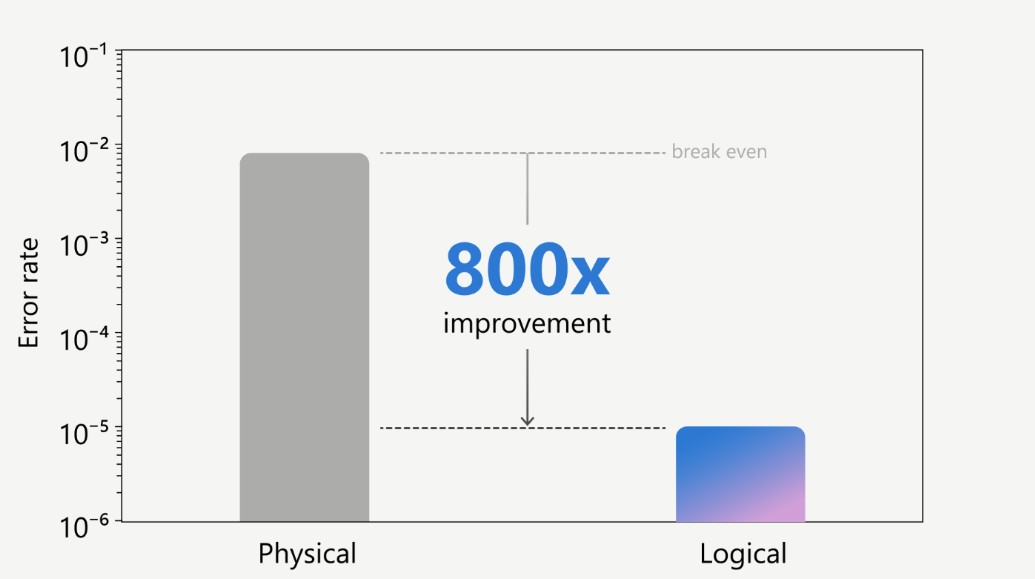
Image Credits: Microsoft

The researchers note that to move beyond NISQ, a large separation between logical and physical qubit error rates is necessary, as is the ability to correct individual circuit errors and create entanglement between at least two logical qubits. If these results hold, then the team has achieved all three and we are indeed in one constant season in the age of durable quantum computers.

As it turns out, the most important result here may actually be the team’s ability to perform “active syndrome extraction” — that is, the ability to diagnose an error and fix it, without destroying the logic qubit in the process.

“This achievement marks the first step toward being able to correct errors without destroying the logical qubits and represents a fundamental milestone in quantum error correction,” Tom and Svore explain. “We demonstrated this critical element of reliable quantum computing with our qubit virtualization system, which resulted in a reasonably low error rate over multiple rounds of syndrome derivation.”

It will now be up to the rest of the quantum community to replicate these results and implement similar error correction systems. That’s probably just a matter of time.

“Today’s results mark a historic achievement and are a wonderful reflection of how this collaboration continues to push the boundaries for the quantum ecosystem,” said Ilyas Khan, Founder and Chief Product Officer of Quantinuum. “With Microsoft’s state-of-the-art error correction aligned with the world’s most powerful quantum computer and a fully integrated approach, we are so excited for the next evolution in quantum applications and look forward to seeing how our customers and partners take advantage of our solutions, especially as we move towards quantum processors at scale.”

For more details, you can find the technical document here.

computing era Microsoft Quantinuum quantum quantum computing ushered
Share. Facebook Twitter Pinterest LinkedIn Tumblr Email
Previous ArticleStartups Weekly: Let’s see what these Y Combinator guys have been up to right now
Next Article Snapchat disables controversial ‘Solar System’ feature by default after bad press
bhanuprakash.cg
techtost.com
  • Website

Related Posts

Apple’s John Ternus will run one of the most powerful companies in the world. work is a minefield

22 April 2026

Tim Cook steps down as Apple CEO: Here’s a look at his 15-year legacy, from new products and services to China expansion

22 April 2026

Who is John Ternus, the new CEO of Apple?

21 April 2026
Add A Comment

Leave A Reply Cancel Reply

Don't Miss

How SpaceX prompted a $2 billion fundraising with a $60 billion takeover offer

23 April 2026

Elon Musk Admits Millions of Tesla Owners Need Upgrades for True ‘Full Self-Driving’

23 April 2026

Esther and Anne Wojcicki support new healthcare accelerator, fund

23 April 2026
Stay In Touch
  • Facebook
  • YouTube
  • TikTok
  • WhatsApp
  • Twitter
  • Instagram
Fintech

Cash App targets a new type of customer: children aged 6 to 12 years

22 April 2026

Revolut eyes up to $200 billion valuation in potential IPO

22 April 2026

Once close enough for a takeover, Stripe and Airwallex are now going after each other

18 April 2026
Startups

How SpaceX prompted a $2 billion fundraising with a $60 billion takeover offer

Cathie Woods’ ARK makes first major investment in startup Lucra — and it’s not AI

AI research lab NeoCognition offers $40 million to build agents that learn like humans

© 2026 TechTost. All Rights Reserved
  • About Us
  • Contact Us
  • Privacy Policy
  • Terms and Conditions
  • Disclaimer

Type above and press Enter to search. Press Esc to cancel.