


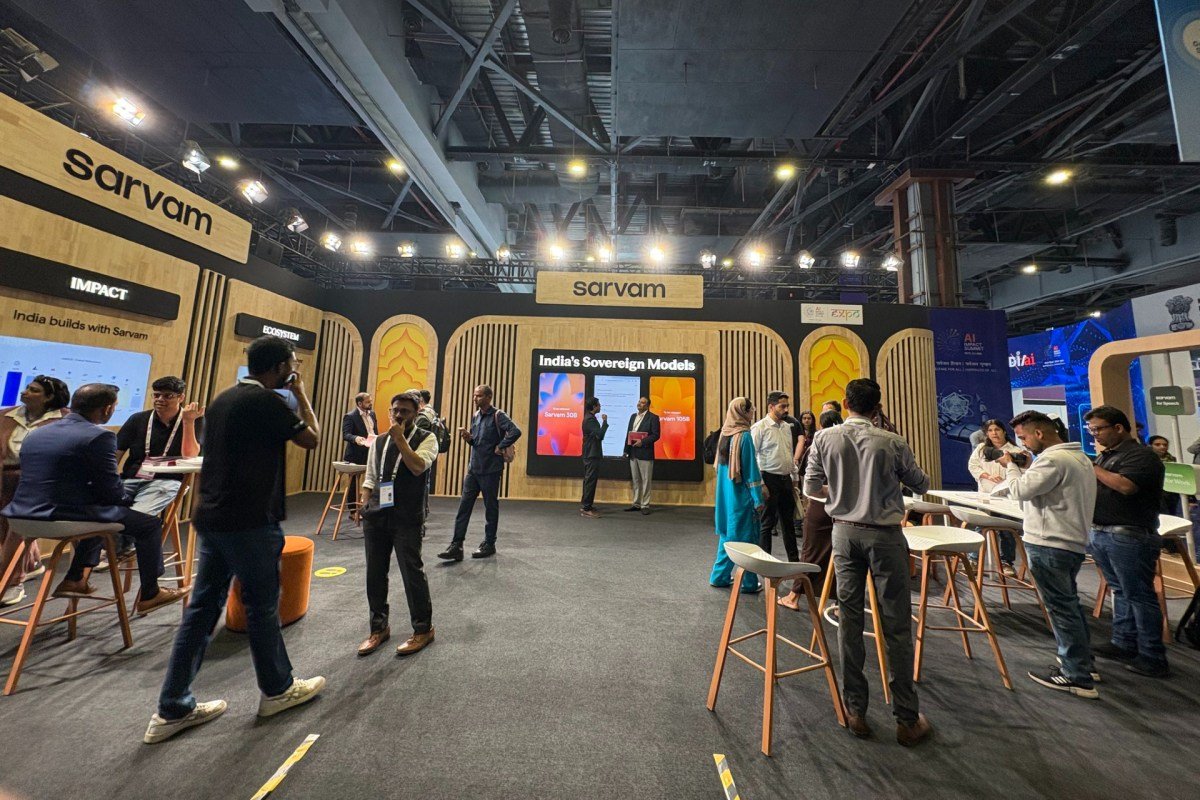
Sarvam has raised $234 million at a $1.5 billion valuation, the company announced Monday. The Bengaluru-based company is now India’s newest AI unicorn as governments and companies seek greater control over critical AI technologies and computing infrastructure.
And $150 million of that money will come from HCLTech, the IT subsidiary of Indian conglomerate HCL Group and a lead strategic investor in the round. Bessemer Venture Partners also participated alongside existing backers Khosla Ventures and Peak XV Partners. Sarvam hopes to raise a total of $300 million for the Series B round.
The investment comes more than two years after Sarvam raised $41 million in seed and Series A rounds, and follows the startup’s release of open-source models at 30 billion and 105 billion parameters earlier this year.
The new funding also reflects a broader push by countries and companies to develop mainstream AI capabilities amid growing concerns about access to advanced models and the computing infrastructure that powers them.
Sarvam is among a handful of startups trying to build a full-stack AI business, covering model development, inference infrastructure and enterprise applications. The startup says its models are designed for Indian languages and use cases, while its products are deployed in sectors such as banking, insurance, government services and defence.
HCLTech’s investment gives Sarvam a deep-pocketed strategic partner as it seeks to commercialize its technology. The plan is to combine Sarvam’s AI models with HCLTech’s business relationships, engineering workforce and software assets to build AI products for businesses and governments.
Sarvam’s investment comes as India consolidates its position as one of the world’s major AI markets. Both OpenAI and Anthropic have described India as their second largest market after the US, driven by the country’s huge base of developers, businesses and consumers adopting AI tools.
Despite its scale as an AI consumer, India has produced few serious contenders in the AI model development race. High computer costs and limited access to capital have made it difficult for Indian startups to compete with well-funded rivals in the US and China, leaving Sarvam among a small group of companies trying to build domestic foundation models.
The AI dominance debate took on new urgency last week when Anthropic disabled access to its latest models, the Fable 5 and Mythos 5, after the US government ordered the company to suspend their use by any foreign national, citing national security concerns. The move highlighted how access to cutting-edge AI systems remains concentrated in a small number of overseas providers.
With the new investment, Sarvam said it will fund research into next-generation AI models focused on agent, coding and cybersecurity applications, while also expanding access to computing infrastructure as it scales deployments across industries.
Sarvam said its AI chat platform now handles more than 2 million interactions a day, while its inference platform processes about 10 million API calls daily. Its speech models transcribe more than 500,000 hours of audio each month, and its document AI systems are used to digitize more than 35 million pages of records.
These tools are increasingly being developed at scale. The company said its multilingual representatives have collected data from 17 million farmers for India’s Ministry of Agriculture and Farmers Welfare. Additionally, a nationwide voice campaign for a leading insurance company helped support policy renewals for 45 million policyholders.
Beyond government and consumer-facing applications, Sarvam said a major fintech company is using its AI platform to support a sales force of more than 350,000 people.
The startup was founded by Vivek Raghavan and Pratyush Kumar, who previously worked at AI4Bharat, an AI research initiative in India at the Indian Institute of Technology Madras backed by tech veteran Nandan Nilekani.
“Our ambition is to spread this technology widely across India, creating significant value across the board for citizens, small businesses, enterprises and state and central governments,” said Raghavan. “We’re in a position to help them adopt and innovate in AI.”
When you purchase through links in our articles, we may earn a small commission. This does not affect our editorial independence.
