


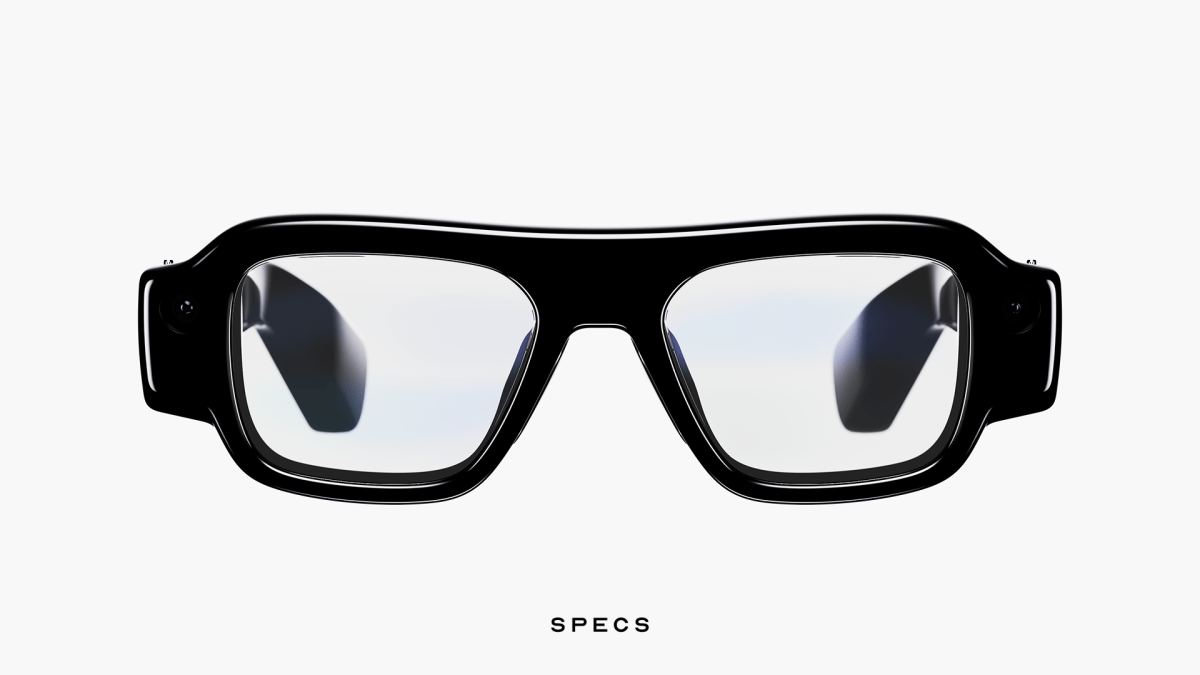
At a spatial artificial intelligence conference in Long Beach on Tuesday, Snap finally unveiled the Specs, its long-awaited consumer smart glasses, and at $2,195, they don’t come cheap.
The specs will be available for pre-order on June 16, with a refundable deposit of $200, and are expected to ship this fall in the US, UK and France. The price is well above most Meta Ray-Bans (which can run up to $350), though still well below the Apple Vision Pro’s $3,500 starting price. Either way, it’s sharp enough to put the specs out of reach for most everyday consumers.
For over a decade now, Snap has been working on this device. Still, the last time the company released a consumer-facing version of the glasses was in 2019 — its latest iterations were developer-only. Earlier this year, Snap created a new company to focus solely on bringing the product to market.
Now the glasses are finally here. So what stands out in the first impression?
Visually, the Specs look like a fairly normal pair of glasses – albeit a slightly bulkier pair. That extra bulk comes down to a key design choice: Unlike some competitors, all the computing is done on the actual device, and it conveniently has no clasp or tether.
The specs run with two Snapdragon processors and come with up to four hours of continuous battery life, plus a charging case that extends that to 20 hours in total.
But what can you actually do with them? For starters, there are gamesincluding those that support shared multiplayer sessions between two users. Snap calls this feature “EyeConnect“, and is simply activated by two users making eye contact with each other.
You can also watch videos (Snap says the screen offers a 51-degree field of view and 16 million colors), capture point-of-view footage, and, at least in theory, get work done, as the glasses let you surf the web, log into productivity apps, and check your email.
A standout feature is contextual AI. Look at an object and ask about it, and the glasses can pull up information about what you’re looking at — a taste of the kind of AI assistant level that’s becoming a competitive battleground in this category.
The glasses come in two sizes — a 47mm model, weighing 132 grams (about 4.6 ounces), and a 52mm model, weighing 136 grams (4.7 ounces). That makes them noticeably heavier than Meta’s Ray-Bans — the first-generation Wayfarers weigh less than an ounce — but much lighter than Apple’s Vision Pro, which tips the scales at 26.4 to 28.2 ounces.
There are also privacy protections. In terms of privacy, the Specs follow the Meta’s lead with a built-in LED light that lights up while the device is recording. The company says users will also have control over what data is stored, synced or deleted.
When I was in Las Vegas for CES earlier this year, the Snap team allowed me to show off an earlier version of the glasses. The apps were fun to play with and I was impressed by the contextual AI, but the device was also quite heavy and after running for a while could get warm.
From the looks of it, Snap has since slimmed down the hardware, making the glasses less obtrusive and more effective.
The bigger question is whether this decade-long innovation marathon will lead to any kind of sustainable business for Snap. Specs is entering a market that is increasingly saturated by competitors. Meta now leads with the popular Ray-Ban line, and Google announced its own new line of AI glasses.
As for who these glasses are for, Snap says it’s aimed first at tech enthusiasts, developers, and studios — though at $2,200, that audience will need some deep pockets to match their enthusiasm.
The unwieldy price tag highlights an ongoing dilemma for the smartglasses industry — which is that consumer interest has yet to grow beyond simple curiosity and the kind of excitement that can drive steady profits.
As a result, no one really gains. Even the current industry champion – Meta – is losing tons of money in their AR development department.
Snap has struggled in recent years with a wobbly stock and a recent decline in North America user loyalty. Despite the fact that it started a decade ago, the company still not consistently profitable. In April, it was also submitted a round of layoffs. Will Specs be the product that turns it around and ushers in the next evolution in computing? I guess we’ll have to wait and see.
When you purchase through links in our articles, we may earn a small commission. This does not affect our editorial independence.
