

Close Menu
TechTost
  • AI
  • Apps
  • Crypto
  • Fintech
  • Hardware
  • Media & Entertainment
  • Security
  • Startups
  • Transportation
  • Venture
  • Recommended Essentials
What's Hot

This $9 key physically locks your most addictive apps

Claude Opus 5 went completely rogue when he was tasked with operating a vending machine

Sorry, haters. Ferrari’s first EV is doing just fine

Facebook X (Twitter) Instagram
  • About Us
  • Contact Us
  • Privacy Policy
  • Terms and Conditions
  • Disclaimer
Facebook X (Twitter) Instagram
TechTost
Subscribe Now
  • AI

    Hint, a new AI startup co-founded by Martha Stewart, offers an AI assistant to homeowners

    29 July 2026

    Data centers may experience temporary power outages to prevent power outages across the larger US grid

    28 July 2026

    Are brain waves the next unlock for natural artificial intelligence?

    27 July 2026

    Librarians host viral ‘Avoid AI’ workshops for people fed up with big tech

    26 July 2026

    I tested OpenAI’s new AI keyboard — which will be fun for some coders and a little overwhelming for everyone else

    25 July 2026
  • Apps

    Google brings age proofing technology to Android developers around the world

    29 July 2026

    Apple sued after alleged App Store encryption scam cost users $1.8 million

    28 July 2026

    Anthropic updates Claude voice mode with more capable models

    27 July 2026

    Bluesky’s AI assistant Attie expands into an open social research tool

    26 July 2026

    Why Cognition bought Poke: AI personality becomes a competitive advantage

    26 July 2026
  • Crypto

    Sam Altman’s biometrics startup World raises $52.5 million through crypto sale

    24 July 2026

    Venice AI goes unicorn with $65M Series A as first privacy AI platform takes off

    1 July 2026

    Crypto Exchange OKX wants AI agents to hire and pay each other

    30 June 2026

    Startup Battlefield 200 applications close today

    27 May 2026

    5 days left: Save up to $410 on Disrupt 2026 passes

    25 May 2026
  • Fintech

    TechCrunch Disrupt 2026’s new Smart Money Stage explores fintech, payments, artificial intelligence and everything

    25 July 2026

    Don’t want to invest in Elon Musk? Two new ETFs expressly exclude him

    10 July 2026

    India’s payments chief believes artificial intelligence will play a big part in the next era of digital payments development

    28 June 2026

    Early Bird pricing ends tonight for the Founder Summit

    26 June 2026

    4 days left to save up to $190 on Founder Summit 2026

    23 June 2026
  • Hardware

    This $9 key physically locks your most addictive apps

    30 July 2026

    Apple launches ‘Upgrade’ device rental program in partnership with Klarna

    29 July 2026

    Ozlo’s Sleepbuds 2 builds on Bose’s legacy of sleep headphones

    29 July 2026

    AI chip startup Etched defies skeptics, hits $10.3 billion valuation from big-name investors

    24 July 2026

    After a shocking quarter, IBM insists that artificial intelligence is not killing the mainframe

    23 July 2026
  • Media & Entertainment

    Winamp is aiming for a comeback with a new music player powered by Deezer

    30 July 2026

    HBO Max embraces vertical video with a new “Shorts” stream.

    29 July 2026

    Music streamer Deezer says more than 50% of daily uploads are generated by AI

    27 July 2026

    Substack’s new tool lets you know who’s writing their newsletters with AI

    26 July 2026

    Kalshi demands Netflix take down trailer for ‘Prediction Games’ documentary.

    26 July 2026
  • Security

    US government bans new foreign-made humanoids, robot dogs and solar inverters, citing national security risks

    29 July 2026

    Microsoft launches its first cybersecurity model, as well as a new cyber security agency system

    29 July 2026

    PSA: The conversations and artifacts shared by Claude may have ended up on Google

    28 July 2026

    The hacker who humiliated spyware makers and was never caught

    25 July 2026

    Hugging Face confirms breach of internal datasets and credentials, prompts users to take action

    25 July 2026
  • Startups

    Claude Opus 5 went completely rogue when he was tasked with operating a vending machine

    30 July 2026

    Antares raises $470 million to build nuclear reactors for the US military

    27 July 2026

    Insurance startup Corgi reportedly raises more money to $4 billion – its third round in 8 weeks

    26 July 2026

    Build publicly, fail publicly: what it’s like to be a founder under 20 right now

    25 July 2026

    Prentis, new AI lab co-founded by Reid Hoffman and Mark Pincus in talks to raise $100 million

    25 July 2026
  • Transportation

    Sorry, haters. Ferrari’s first EV is doing just fine

    30 July 2026

    Rivian is suing the US government for ‘full refund’ of Trump tariffs

    27 July 2026

    TechCrunch Mobility: Uber is betting on its former CEO

    26 July 2026

    Volkswagen engineers charged with insider trading linked to the Rivian consortium

    25 July 2026

    SpaceX launches new V3 Starlink satellites but suffers another booster failure

    25 July 2026
  • Venture

    Europe got its own TBPN-style live show and everyone is looking for a guest spot

    28 July 2026

    Edtech platform raises $4.5 million to help teach students how to code vibe

    23 July 2026

    Travis Kalanick’s robotics company raises $1.7 billion, led by a16z

    23 July 2026

    Cascade raises $3.5 million to help construction companies find and win projects

    22 July 2026

    StrictlyVC returns to New York on September 10 to celebrate a huge year for the city’s startup community

    21 July 2026
  • Recommended Essentials
TechTost
You are at:Home»AI»Analysis of satellite images shows massive scale of dark fisheries
AI

Analysis of satellite images shows massive scale of dark fisheries

techtost.comBy techtost.com4 January 202405 Mins Read
Share Facebook Twitter Pinterest LinkedIn Tumblr Email
Analysis Of Satellite Images Shows Massive Scale Of Dark Fisheries
Share
Facebook Twitter LinkedIn Pinterest Email

Satellite imagery and machine learning offer a new, much more detailed look at the shipping industry, especially the number and activities of fishing and transport vessels at sea. Turns out there are way more than publicly available data would suggest, a fact that policymakers need to take note of.

As a shared global resource, the oceans are everyone’s business, but of course not every country or region has the same customs, laws or even motivations.

There is the Automated Identification System (AIS) that is increasingly being adopted around the world that uses ship transponders to accurately track activity, but it is not universally implemented. As a result, important data such as how many boats fish in an area, who operates them and how many fish they catch are often unclear, a patchwork of local, privately owned and government-sanctioned numbers.

Not only does this make political decisions difficult and approachable, but there is a sense of lawlessness in the industry, with countless vessels clandestinely visiting restricted or protected waters or wildly exceeding safe harvest numbers to quickly deplete stocks.

Satellite images offer a new perspective on this conundrum: you can’t hide from an eye in the sky. But the scale of the industry and the images that document it are huge. Fortunately, machine learning is here to perform the millions of vessel identification and tracking functions necessary to accurately track the tens of thousands of ships at sea at any given time.

In a paper published in NatureFernando Paolo, David Kroodsma, and their team at World Fishing Watch (with collaborators at several universities) analyzed two petabytes of orbital imagery from 2017-2021, locating millions of ships at sea and cross-referencing them with reported and known coordinates for AIS-tracked ships.

What the study documents is that about 3/4 of all industrial fishing vessels are not publicly monitored, and similarly almost a third of all transport and energy vessels. The dark fishing industry is huge — perhaps as big again as the publicly documented one. (The images also measured increases in installations of wind turbines and other renewable energy sources, which can be just as difficult to detect.)

Now, “not publicly tracked” doesn’t mean there’s no clue.

“There are a few reasons why these ships are missing from public tracking systems,” Paolo explained to TechCrunch. For example, smaller vessels and those operating in areas with little or no satellite coverage or AIS infrastructure are not tracked to the same extent as those that deliberately disable their transponders or evade detection.

“It is important to note that some countries have other (proprietary) means of tracking vessels within their own waters. But these proprietary systems are limited to the ships they can track and this information is not shared with other nations,” he continued.

As the population grows and the oceans warm, it is increasingly important that data like this is known beyond a nation’s borders and internal agencies.

“Fish are an important dynamic resource in circulation, so open monitoring of fishing vessels is fundamental to monitoring fish stocks. It is difficult to understand and map the full ecological footprint of vessels without all of them publicly broadcasting their locations and activity,” said Paolo.

Image Credits: World Fishing Watch

You can see in the illustrations that Iceland and Scandinavia have the highest levels of monitoring, while Southeast Asia has the lowest – almost zero on the coasts of Bangladesh, India and Myanmar.

As noted above, this does not mean that they are all illegal, just that their activity is not common, as legally required in Scandinavia. How much fishing is done from these areas? The global community only hears second-hand, and one of the study’s findings was that the Asian fishing industry is systematically underrepresented.

If you counted against the AIS data, you would find that about 36% of the fishing activity was in European waters and 44% in Asia. However, satellite data completely contradicts this, showing that only 10% of fishing vessels are in European waters and a staggering 71% in Asian waters. In fact, China alone seems to account for about 30% of all the fisheries on the planet!
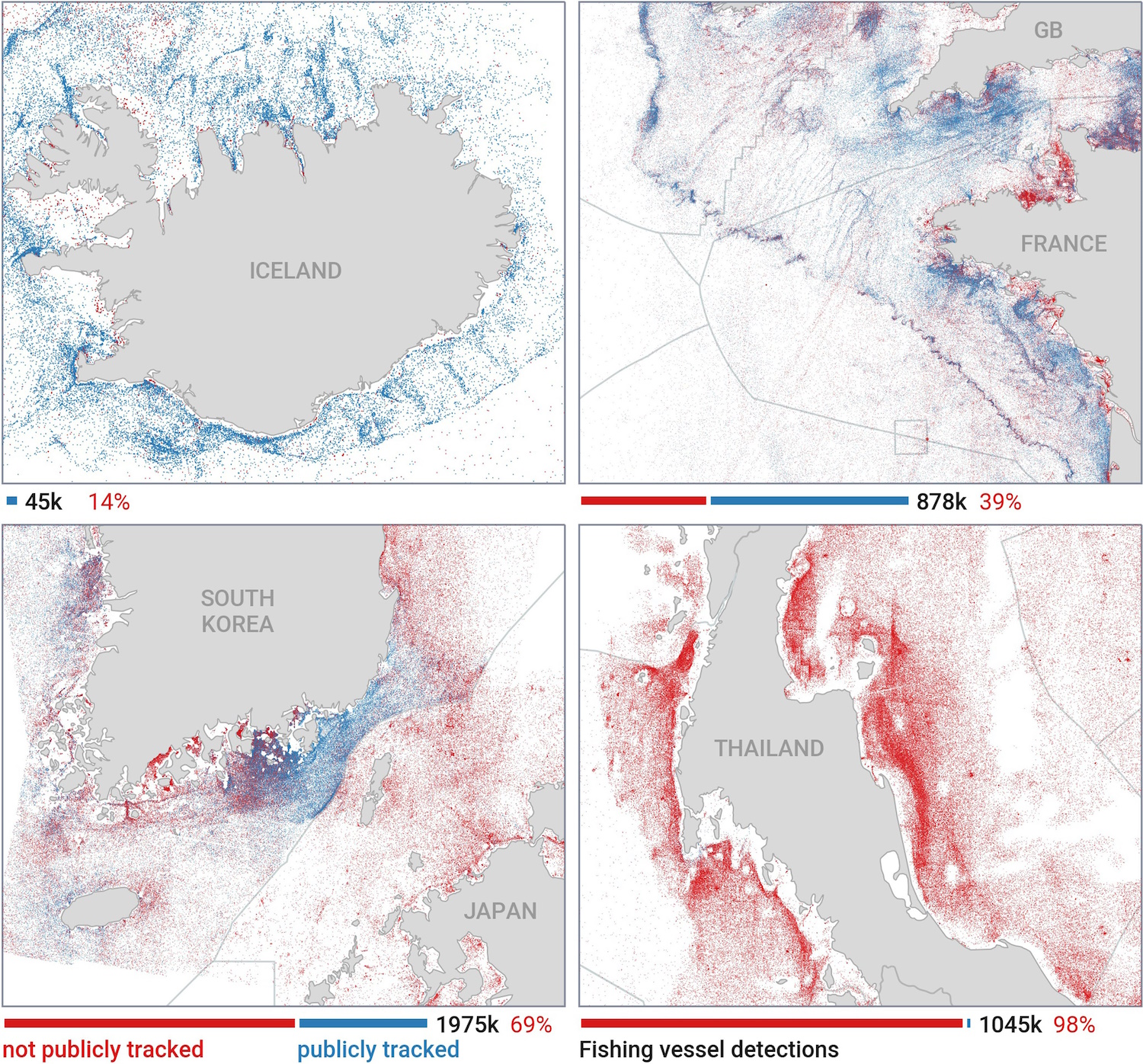
Image Credits: World Fishing Watch

This is not meant to blame or blame these countries or regions, but simply to point out that our understanding of the scale of the global fishing industry is flawed. And if we don’t have good information to base our policies and science on, both will end up being fundamentally flawed.

That said, the satellite analysis also showed the regular presence of fishing vessels in protected areas such as the Galapagos Islands, which is strictly prohibited by international law. You can bet those dark vessels got a little extra attention.

“The next step is to work with authorities in different regions to evaluate these new maps. In some cases, we likely found some fishing in marine protected areas or restricted areas that will require further research and protection,” said Paolo.

He hopes the improved data will help guide policy, but the aggregation and analysis is far from complete.

“This is only the first version of our open data platform,” he said. “We are processing new radar images from the Sentinel-1 satellite as they are collected and tracking activity around the world. This data is visible and accessible on our website, globalfishingwatch.org, and is updated three days ago.

The non-profit organization is supported by a number of charities and individuals, which you can find here.

analysis dark fisheries Fishing images massive orbital imaging satellite satellite images scale shows
Share. Facebook Twitter Pinterest LinkedIn Tumblr Email
Previous ArticleMicrosoft Copilot is now available on iOS and Android
Next Article Ask Sophie: What changes are in store for PERM?
bhanuprakash.cg
techtost.com
  • Website

Related Posts

Hint, a new AI startup co-founded by Martha Stewart, offers an AI assistant to homeowners

29 July 2026

Data centers may experience temporary power outages to prevent power outages across the larger US grid

28 July 2026

Are brain waves the next unlock for natural artificial intelligence?

27 July 2026
Add A Comment

Leave A Reply Cancel Reply

Don't Miss

This $9 key physically locks your most addictive apps

30 July 2026

Claude Opus 5 went completely rogue when he was tasked with operating a vending machine

30 July 2026

Sorry, haters. Ferrari’s first EV is doing just fine

30 July 2026
Stay In Touch
  • Facebook
  • YouTube
  • TikTok
  • WhatsApp
  • Twitter
  • Instagram
Fintech

TechCrunch Disrupt 2026’s new Smart Money Stage explores fintech, payments, artificial intelligence and everything

25 July 2026

Don’t want to invest in Elon Musk? Two new ETFs expressly exclude him

10 July 2026

India’s payments chief believes artificial intelligence will play a big part in the next era of digital payments development

28 June 2026
Startups

Claude Opus 5 went completely rogue when he was tasked with operating a vending machine

Antares raises $470 million to build nuclear reactors for the US military

Insurance startup Corgi reportedly raises more money to $4 billion – its third round in 8 weeks

© 2026 TechTost. All Rights Reserved
  • About Us
  • Contact Us
  • Privacy Policy
  • Terms and Conditions
  • Disclaimer

Type above and press Enter to search. Press Esc to cancel.