

Close Menu
TechTost
  • AI
  • Apps
  • Crypto
  • Fintech
  • Hardware
  • Media & Entertainment
  • Security
  • Startups
  • Transportation
  • Venture
  • Recommended Essentials
What's Hot

OpenAI acquires TBPN, the popular founder-led business talk show

Money transfer app Duc has exposed thousands of driver’s licenses and passports to the open web

Different teams start with different VCs

Facebook X (Twitter) Instagram
  • About Us
  • Contact Us
  • Privacy Policy
  • Terms and Conditions
  • Disclaimer
Facebook X (Twitter) Instagram
TechTost
Subscribe Now
  • AI

    Salesforce announces a heavy overhaul for Slack, with 30 new features

    2 April 2026

    Meta’s gas glut could power South Dakota

    2 April 2026

    Anthropic is one month old

    1 April 2026

    Mercor Says It Was Hit By Cyber ​​Attack Linked To Compromise Of LiteLLM Open Source Project

    1 April 2026

    With its new app store, Ring bets on artificial intelligence to overcome home security

    31 March 2026
  • Apps

    Exclusive: Beehiiv expands into podcasting, targeting Patreon

    2 April 2026

    A new dating app, Sonder, has a deliberately annoying sign-up process (and it works)

    2 April 2026

    Truecaller Caller ID app reaches 500 million monthly users

    1 April 2026

    Go play this secret game in the TikTok DMs

    1 April 2026

    Speechify’s Windows app uses local models for transcription and dictation

    31 March 2026
  • Crypto

    Hackers stole over $2.7 billion in crypto in 2025, data shows

    23 December 2025

    New report examines how David Sachs may benefit from Trump administration role

    1 December 2025

    Why Benchmark Made a Rare Crypto Bet on Trading App Fomo, with $17M Series A

    6 November 2025

    Solana co-founder Anatoly Yakovenko is a big fan of agentic coding

    30 October 2025

    MoviePass opens Mogul fantasy league game to the public

    29 October 2025
  • Fintech

    Doss raises $55 million for AI inventory management that connects to ERP

    24 March 2026

    Despite stiff competition, Kalshi, Polymarket CEOs back $35m VC fund projections

    23 March 2026

    Amid legal turmoil, Kalshi is temporarily banned in Nevada

    20 March 2026

    Nominations for the Startup Battlefield 200 are still open

    19 March 2026

    Kalshi’s legal woes pile up as Arizona files first criminal charges for ‘illegal gambling operation’

    17 March 2026
  • Hardware

    Nothing’s AI device design reportedly includes smart glasses and headphones

    2 April 2026

    Cognichip wants AI to design the chips that power AI, and it just raised $60 million to test

    2 April 2026

    Meta launches two new Ray-Ban glasses designed for prescription wearers

    1 April 2026

    Whoop’s valuation just tripled to $10 billion

    1 April 2026

    The Pixel 10a doesn’t have a camera bump, and it’s great

    30 March 2026
  • Media & Entertainment

    OpenAI acquires TBPN, the popular founder-led business talk show

    2 April 2026

    Roku is launching a standalone app for Howdy, its $2.99 ​​streaming service

    31 March 2026

    SXSW is making a comeback as a premier networking, ideas festival for founders and VCs

    30 March 2026

    ‘Project Hail Mary’ becomes Amazon MGM’s biggest box office hit

    30 March 2026

    Sora’s shutdown could be a reality check moment for video AI

    29 March 2026
  • Security

    Money transfer app Duc has exposed thousands of driver’s licenses and passports to the open web

    2 April 2026

    Apple releases security patch for older iPhones and iPads to protect against DarkSword attacks

    2 April 2026

    WhatsApp is alerting hundreds of users who installed a fake app made by a government-run spyware maker

    1 April 2026

    Health data giant CareCloud says hackers accessed patient medical records

    1 April 2026

    North Korean hackers accused of hijacking popular open source project Axios to spread malware

    31 March 2026
  • Startups

    Different teams start with different VCs

    2 April 2026

    YC’s troubled startup Delve’s reputation just got worse

    2 April 2026

    StrictlyVC San Francisco is less than a month away

    1 April 2026

    It’s not your imagination: AI startups have higher valuations

    1 April 2026

    The company behind ClassPass and Mindbody just got a lot bigger with a $7.5 billion merger

    31 March 2026
  • Transportation

    Tesla’s cheaper vehicles aren’t helping its declining sales

    2 April 2026

    The Rivian spinoff will also build autonomous delivery vehicles for DoorDash

    2 April 2026

    Uber and WeRide are ramping up robotaxi operations in Dubai

    1 April 2026

    Robotaxi companies decline to say how often their AVs need remote assistance

    1 April 2026

    TechCrunch Mobility: When a robotaxi needs to call 911

    30 March 2026
  • Venture

    Toyota’s Woven Capital appoints new CIO and COO in push to find ‘future of mobility’

    1 April 2026

    Exclusive: Runway Launches $10M Fund, Builders Program to Back Early-Stage AI Startups

    31 March 2026

    Former Coatue Partner Raises Massive $65M Seed Fund for Enterprise AI Agent Startup

    31 March 2026

    From Moon Hotels to Cattle Grazing: 8 Startup Investors Hunted at YC Demo Day

    28 March 2026

    16 of the most interesting startups from the YC W26 Demo Day

    27 March 2026
  • Recommended Essentials
TechTost
You are at:Home»Hardware»Microsoft and Quantinuum say they have ushered in the next era of quantum computing
Hardware

Microsoft and Quantinuum say they have ushered in the next era of quantum computing

techtost.comBy techtost.com6 April 202405 Mins Read
Share Facebook Twitter Pinterest LinkedIn Tumblr Email
Microsoft And Quantinuum Say They Have Ushered In The Next
Share
Facebook Twitter LinkedIn Pinterest Email

Microsoft and Quantinuum today was announced a breakthrough in quantum error correction. Using Quantinuum’s ion-trap hardware and Microsoft’s new qubit virtualization system, the team was able to run more than 14,000 experiments without a single error. This new system also allowed the team to test the logic qubits and fix any errors they encountered without destroying the logic qubits.

This, the two companies say, has now moved the state of the art of quantum computing out of what has commonly been called the era of noisy intermediate-scale quantum computing (NISQ). “Noisy” because even the smallest changes in the environment can cause a quantum system to become essentially random (or “decay”) and “intermediate scale” because the current generation of quantum computers is still limited to little more than a thousand qubits at best . A qubit is the fundamental unit of computation in quantum systems, analogous to a bit in a classical computer, but each qubit can be in many states at once and does not fall into a specific position until it is measured, which is the basis of the quantum possibility for to provide a huge leap in computing power.

It doesn’t matter how many qubits you have, however, if you don’t have time to run a basic algorithm before the system becomes too noisy to get a useful result — or any result at all.

By combining many different techniques, the team was able to run thousands of experiments with virtually no errors. This involved a lot of preparation and pre-selection of systems that already seemed to be in good shape for a successful run, but still, this is a huge improvement from where the industry was a while ago.

It’s a step in the right direction for quantum computing. There are still many problems to be solved (and these results need to be reproduced, of course), but in theory, a computer with 100 of these logical qubits could already be useful for solving some problems, while a machine with 1,000 qubits could, says Microsoft, “unlock commercial advantage.”

The deviations (errors) between entangled qubits. Discrepancies are revealed by comparing the images from each qubit in a pair, and any differences that exist are shown as dots in the central image between each pair. Image Credits: Microsoft

The team used Quantinuum’s Trapped Ion Processor H2 and was able to combine 30 physical qubits into four highly reliable logical qubits. Encoding multiple physical qubits into a single logical qubit helps protect the system from errors. Physical qubits are entangled with each other so that an error in a physical qubit can be detected and corrected.

It is this error correction that has long troubled the industry: the lower the noise and the higher the quality of the physical qubits, the better, of course, but without complex error correction, there is no way out of the NISQ era, because these systems will all de-coordinate sooner rather than later.

“Simply increasing the number of physical qubits with a high error rate – without improving that error rate – is futile, because doing so would result in a large quantum computer that is no more powerful than before,” said Dennis Tom, general manager of Azure. Quantum and Krysta Svore, Vice President of Advanced Quantum Development at Microsoft, wrote in today’s announcement. “In contrast, when physical qubits with sufficient operational quality are used with a specialized instrumentation and diagnostics system to enable virtual qubits, only then increasing the number of physical qubits leads to powerful, fault-tolerant quantum computers capable of higher performance. , more complex calculation.”

It was alone a few years ago that logical qubits began to outperform physical qubits. Now, Microsoft and Quantinuum claim their new hardware/software system exhibits the largest gap between physical and logical error rates, improving the use of only physical qubits by up to 800x.
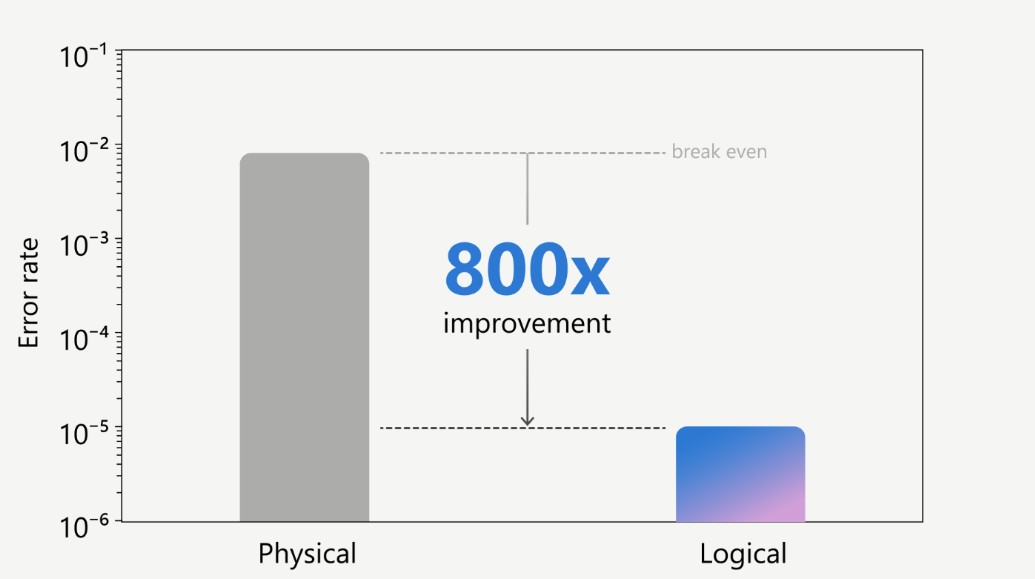
Image Credits: Microsoft

The researchers note that to move beyond NISQ, a large separation between logical and physical qubit error rates is necessary, as is the ability to correct individual circuit errors and create entanglement between at least two logical qubits. If these results hold, then the team has achieved all three and we are indeed in one constant season in the age of durable quantum computers.

As it turns out, the most important result here may actually be the team’s ability to perform “active syndrome extraction” — that is, the ability to diagnose an error and fix it, without destroying the logic qubit in the process.

“This achievement marks the first step toward being able to correct errors without destroying the logical qubits and represents a fundamental milestone in quantum error correction,” Tom and Svore explain. “We demonstrated this critical element of reliable quantum computing with our qubit virtualization system, which resulted in a reasonably low error rate over multiple rounds of syndrome derivation.”

It will now be up to the rest of the quantum community to replicate these results and implement similar error correction systems. That’s probably just a matter of time.

“Today’s results mark a historic achievement and are a wonderful reflection of how this collaboration continues to push the boundaries for the quantum ecosystem,” said Ilyas Khan, Founder and Chief Product Officer of Quantinuum. “With Microsoft’s state-of-the-art error correction aligned with the world’s most powerful quantum computer and a fully integrated approach, we are so excited for the next evolution in quantum applications and look forward to seeing how our customers and partners take advantage of our solutions, especially as we move towards quantum processors at scale.”

For more details, you can find the technical document here.

computing era Microsoft Quantinuum quantum quantum computing ushered
Share. Facebook Twitter Pinterest LinkedIn Tumblr Email
Previous ArticleStartups Weekly: Let’s see what these Y Combinator guys have been up to right now
Next Article Snapchat disables controversial ‘Solar System’ feature by default after bad press
bhanuprakash.cg
techtost.com
  • Website

Related Posts

Nothing’s AI device design reportedly includes smart glasses and headphones

2 April 2026

Cognichip wants AI to design the chips that power AI, and it just raised $60 million to test

2 April 2026

Meta launches two new Ray-Ban glasses designed for prescription wearers

1 April 2026
Add A Comment

Leave A Reply Cancel Reply

Don't Miss

OpenAI acquires TBPN, the popular founder-led business talk show

2 April 2026

Money transfer app Duc has exposed thousands of driver’s licenses and passports to the open web

2 April 2026

Different teams start with different VCs

2 April 2026
Stay In Touch
  • Facebook
  • YouTube
  • TikTok
  • WhatsApp
  • Twitter
  • Instagram
Fintech

Doss raises $55 million for AI inventory management that connects to ERP

24 March 2026

Despite stiff competition, Kalshi, Polymarket CEOs back $35m VC fund projections

23 March 2026

Amid legal turmoil, Kalshi is temporarily banned in Nevada

20 March 2026
Startups

Different teams start with different VCs

YC’s troubled startup Delve’s reputation just got worse

StrictlyVC San Francisco is less than a month away

© 2026 TechTost. All Rights Reserved
  • About Us
  • Contact Us
  • Privacy Policy
  • Terms and Conditions
  • Disclaimer

Type above and press Enter to search. Press Esc to cancel.