


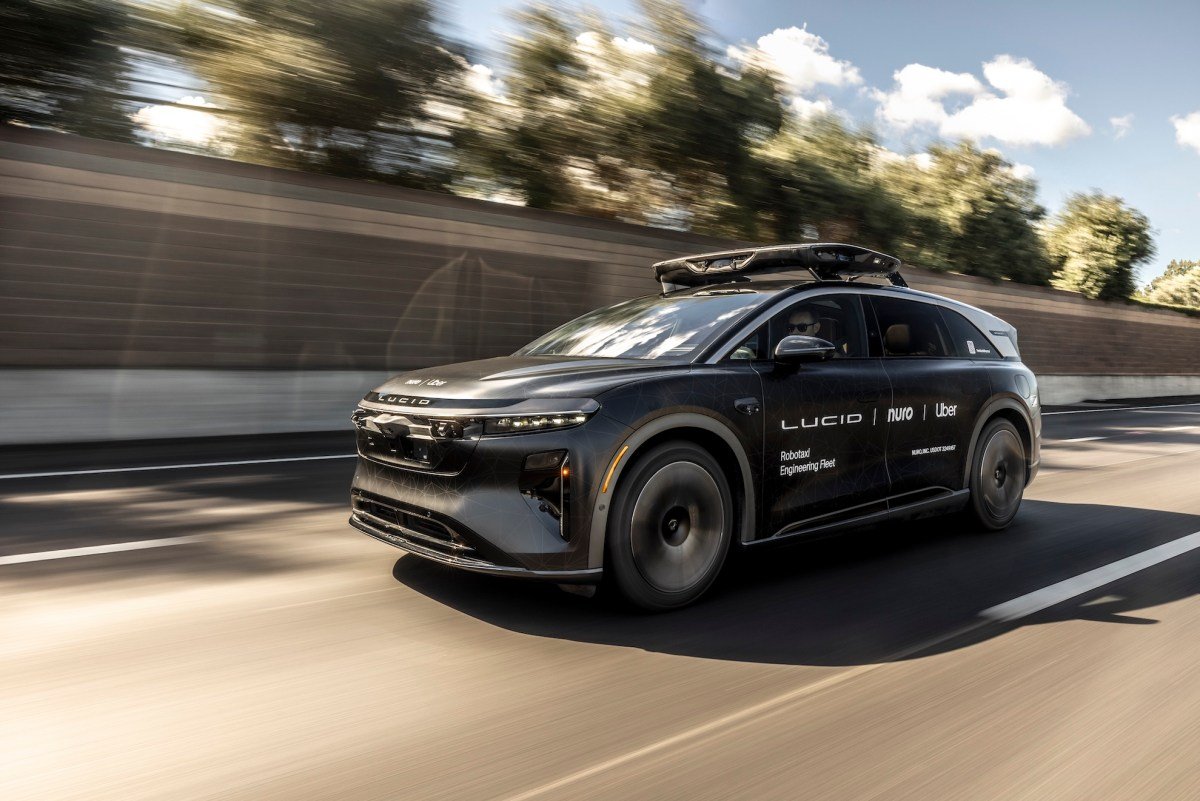
If you spot a Lucid Gravity SUV with sensors—and a self-driving system developed by Nuro—driving around San Francisco, chances are an Uber employee is hitching a ride.
Select Uber employees can now request a ride in a Lucid robotaxi through the Uber app, the final phase of testing before a planned public launch later this year. Nuro, who provided the update on a blog posted on Monday, told TechCrunch that the vehicles operate in autonomous mode and have a human safety operator behind the wheel as a backup.
While that’s a long way from a public launch, it marks the companies’ progress since announcing a partnership and a multimillion-dollar investment in July 2025. Uber invested $300 million in Lucid and separately agreed to buy “at least” 20,000 of the EV maker’s new Gravity SUV over the next six years.
These EVs are equipped with Nuro’s autonomous vehicle system, which is powered by Nvidia’s Drive AGX Thor computer. Unveiled in January, the Lucid Gravity robot taxi is equipped with high-resolution cameras, solid-state lidar sensors, and radar that help the self-driving system perceive and operate within its real-world environment.
Uber also invested an undisclosed sum of “several hundreds of millions of dollars” in Nuro.
The plan is for Uber to own and operate — likely with the help of a third party — the premium robotaxi service. Production of these modified Lucid Gravity vehicles is expected to begin in late 2026, according to regulatory filing published last year.
Nuro completed closed-track testing and began the first public road tests of the Lucid Gravity autonomous SUV late last year. Nuro now has 100 Lucid Gravity SUVs equipped with its self-driving system in its engineering fleet, which is used to collect real-world data and test self-driving in several US cities and states.
Techcrunch event
San Francisco, California
|
13-15 October 2026
According to Nuro, employee test drives help the team evaluate how the autonomy stack, vehicle and rider experience work together and operate in a live operating environment. It also allows the team to test how well the vehicle handles rider pickups and drop-offs, an extremely difficult function in autonomous driving.
